


In the field of modern industrial manufacturing, welding technology, as a crucial process for joining materials, plays a decisive role in product quality and production efficiency. Metal Inert Gas (MIG) welding and laser welding, as two widely used welding techniques, each have their unique advantages and limitations. A deep understanding of their pros and cons helps enterprises select the most suitable welding method according to different production requirements and process specifications, thereby enhancing production efficiency and product quality.
I. Basic Principles of MIG Welding and Laser Welding
MIG welding is an arc welding method. It utilizes the arc burning between the continuously fed wire electrode and the workpiece as the heat source, and uses inert gases (such as argon) or mixed gases as the shielding gas to prevent the metal in the welding area from reacting with oxygen, nitrogen, and other substances in the air, thus ensuring the welding quality. During the welding process, the wire electrode continuously melts and fills the weld joint, forming a strong welding seam. This welding method is relatively flexible in operation. By adjusting parameters such as welding current, voltage, and gas flow rate, it can adapt to the welding of workpieces with different thicknesses and materials.
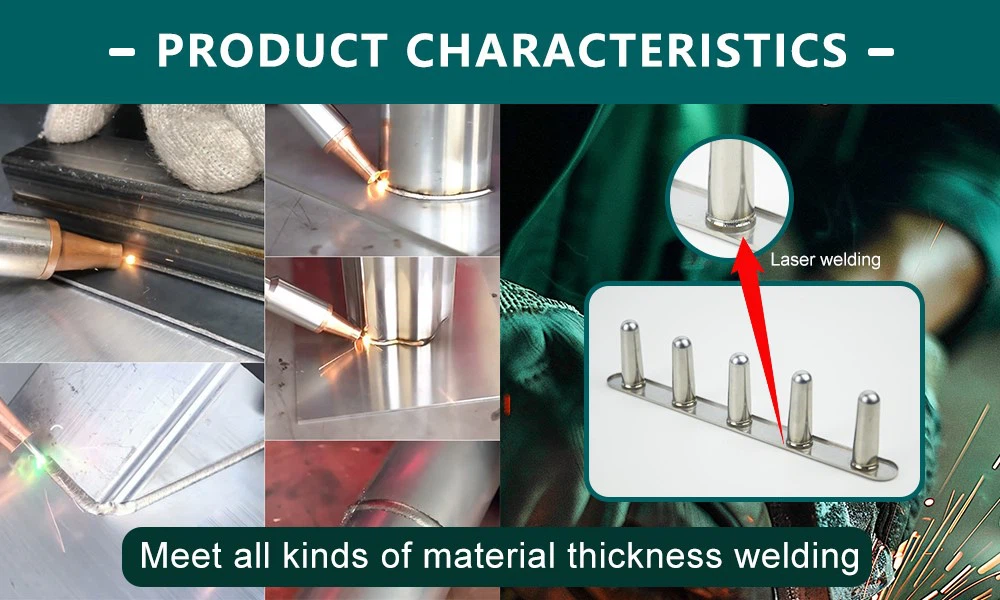
Laser welding, on the other hand, uses a high-energy-density laser beam as the heat source, causing the material to melt and vaporize instantaneously to form a welding joint. The laser beam can be precisely focused through an optical system, with highly concentrated energy, enabling rapid welding. According to the laser output mode and welding process, laser welding can be divided into pulsed laser welding, continuous laser welding, and other types. The high energy density of the laser makes the welding process non-contact, with a small heat-affected zone, enabling precise welding.
II. Advantages of MIG Welding
(1) Good Adaptability
MIG welding has strong adaptability to welding positions and workpiece shapes. Whether it is flat welding, vertical welding, horizontal welding, or overhead welding, MIG welding can complete the welding task well. For some workpieces with complex and irregular shapes, welders can achieve high-quality welding by flexibly adjusting the angle and position of the welding torch. For example, in the manufacturing of automotive parts, for components with complex curved surfaces, MIG welding can be carried out manually or by robots to successfully complete the welding work.
(2) Controllable Filler Metal
During the MIG welding process, the wire electrode serves as the filler metal, and its composition can be selected according to welding requirements. By choosing wire electrodes with different compositions, the mechanical properties and chemical composition of the weld metal can be adjusted to meet different usage
requirements.
For instance, when welding high-strength steel, wire electrodes with a higher alloy content can be selected to improve the strength and toughness of the weld seam. When welding non-ferrous metals, there are also corresponding special wire electrodes available to ensure the quality of the welding joint.
(3) Relatively Low Equipment Cost
Compared with laser welding equipment, the cost of MIG welding equipment is lower. MIG welding equipment mainly includes a welding power source, wire feeder, welding torch, gas supply system, etc. Its structure is relatively simple, and the manufacturing and maintenance costs are not high. This makes MIG welding widely used in small and medium-sized enterprises that are sensitive to costs. In addition, the operation and maintenance of MIG welding equipment are relatively easy. Ordinary welders can master the operation skills proficiently after a certain amount of training.
III. Disadvantages of MIG Welding
(1) Low Welding Efficiency
The welding speed of MIG welding is relatively slow. Especially when welding thick workpieces, multi-layer and multi-pass welding is required, resulting in a significant increase in welding time. This is because MIG welding relies on the heat of the arc to melt the wire electrode and the workpiece, with a relatively low energy density and limited deposition rate. In large-scale production, the low welding efficiency may affect the production schedule and increase production costs.
(2) Large Heat-Affected Zone
Due to the relatively wide distribution of arc heat in MIG welding, a large area of the metal around the weld seam is heated and cooled during the welding process, resulting in a large heat-affected zone. A large heat-affected zone may cause changes in the structure and properties of the welding joint, such as coarse grains and reduced hardness, thereby affecting the mechanical properties and service life of the welding joint. Especially for some heat-sensitive materials, such as aluminum alloys and stainless steels, the adverse effects of the heat-affected zone are more obvious.
(3) Large Welding Deformation
During the MIG welding process, due to the large heat input, the workpiece is prone to deformation after welding. Welding deformation not only affects the dimensional accuracy and appearance quality of the workpiece but may also require additional subsequent straightening processes, further increasing production costs and production cycles. For workpieces with high precision requirements, the deformation problem caused by MIG welding may become an important factor limiting its application.
IV. Advantages of Laser Welding
(1) High Welding Speed and Efficiency
The energy density of laser welding is extremely high, enabling the material to melt and vaporize in an extremely short time, so the welding speed is very fast. Compared with MIG welding, the welding speed of laser welding can be increased by several times or even dozens of times. In large-scale production, the high-efficiency advantage of laser welding can significantly improve production efficiency and reduce production costs. For example, in the automotive manufacturing industry, laser welding is widely used in body welding, greatly shortening the production cycle of automobiles.
(2) Small Heat-Affected Zone and Deformation
Due to the highly concentrated energy of the laser beam, only the material at the weld seam is rapidly heated and cooled during the welding process, resulting in a very small heat-affected zone around the weld seam. A small heat-affected zone causes minimal changes in the structure and properties of the welding joint, enabling it to maintain the original mechanical and physical properties of the material. At the same time, the small heat-affected zone also results in minimal welding deformation. For workpieces with high precision requirements, laser welding can meet their dimensional accuracy requirements and reduce subsequent straightening processes.
(3) High Welding Quality
Laser welding can achieve high-quality welding joints with smooth and flat weld surfaces and few internal defects. Since there is no consumption and contamination of electrodes during laser welding, and the shielding effect is good, it can effectively avoid the occurrence of welding defects such as pores and slag inclusions. In addition, laser welding can also achieve deep penetration welding, with a large depth-to-width ratio of the weld seam, ensuring the strength and reliability of the welding joint. Laser welding is widely used in fields with extremely high requirements for welding quality, such as aerospace and electronics.
V. Disadvantages of Laser Welding
(1) High Equipment Cost
Laser welding equipment mainly includes a laser generator, optical focusing system, control system, etc. With high technical content and complex manufacturing processes, the equipment cost is extremely expensive. In addition, the maintenance cost of laser welding equipment is also high, requiring professional technicians for maintenance and upkeep, increasing the operating costs of enterprises. This makes the initial investment in laser welding equipment relatively large, which is difficult for some enterprises with limited financial resources to afford.
(2) High Requirements for Workpiece Assembly Accuracy
The spot diameter of the laser beam is very small, and the energy is concentrated in a very small area, so the requirements for the assembly accuracy of workpieces are extremely high. If the assembly error of the workpiece is large, it may cause the laser to fail to act accurately on the weld seam, thus affecting the welding quality or even making it impossible to complete the welding. In actual production, in order to ensure the quality of laser welding, high-precision assembly fixtures and inspection equipment need to be used, increasing production preparation costs and time.
(3) Limited Adaptability to Materials
Although laser welding can weld a variety of materials, it still faces certain difficulties when welding some materials with high reflectivity, such as copper and aluminum. These materials have a high reflectivity to laser, resulting in low absorption of laser energy, making it difficult to achieve effective melting and welding during the welding process. In addition, when welding dissimilar materials, laser welding may also produce welding defects due to the large differences in the physical and chemical properties of the materials, affecting the performance of the welding joint.
VI. Conclusion
Both MIG welding and laser welding have their own advantages and disadvantages. In practical applications, enterprises need to comprehensively consider factors such as specific production requirements, product characteristics, and cost budgets to select the appropriate welding method. MIG welding is suitable for occasions where equipment cost is a concern, the welding position and workpiece shape are complex, and the requirement for welding speed is not high.
Laser welding, on the other hand, is more suitable for large-scale production, fields with high requirements for welding quality and accuracy, and situations where strict requirements are imposed on the heat-affected zone and deformation. With the continuous development of welding technology, in the future, MIG welding and laser welding may integrate with each other, complementing their advantages and bringing more innovations and development opportunities to industrial manufacturing.
--Rayther Laser Jack Sun--