


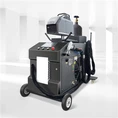
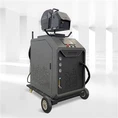

1. Two Core Welding Technologies in the Industry
Laser welding machines and TIG welding are both crucial technologies in the modern welding field, each with unique characteristics and application scenarios. This article focuses on comparing their respective advantages and disadvantages to provide references for practical application selection.
2. Unveiling the Working Principles
2.1 Working Principle of Laser Welding Machines
Laser welding machines utilize high-energy laser beams to melt the material of workpieces for welding. They mainly operate in two modes: heat conduction welding and deep penetration welding. In heat conduction welding, the laser energy heats the workpiece surface, and heat is transferred inward through conduction to form a molten pool. In deep penetration welding, the laser energy is highly concentrated to create keyholes in the workpiece, enabling rapid melting and fusion of the material.
2.2 Working Principle of TIG Welding
TIG welding, also known as gas tungsten arc welding, generates an electric arc between a tungsten electrode and the workpiece to heat and melt the base material. During the welding process, an inert gas (usually argon) is continuously supplied around the arc and molten pool to isolate air, preventing oxidation of the molten metal and ensuring the quality of the weld.
3. A Contest of Welding Precision
3.1 Precision Advantages of Laser Welding Machines
Laser welding machines feature a small laser spot, which allows for precise control of the welding area. This makes them suitable for welding tiny components and precision products, such as electronic components and micro-mechanical parts. The narrow weld seam formed by laser welding also reduces the need for subsequent processing.
3.2 Precision Performance of TIG Welding
TIG welding can achieve high-quality welds with good surface finish. However, when welding extremely small and delicate parts, its precision is slightly lower than that of laser welding machines. The width of the weld seam in TIG welding is relatively larger, and it requires more careful operation to ensure the accuracy of the welding position.
4. Competition in Welding Speed and Efficiency
4.1 High-Efficiency Welding of Laser Welding Machines
Laser welding machines have a fast welding speed due to the high energy density of the laser beam. In large-scale mass production, they can significantly shorten the production cycle and improve overall production efficiency. This advantage is particularly evident in industries with high output requirements, such as the automotive manufacturing sector.
4.2 Speed Limitations of TIG Welding
TIG welding has a relatively slow welding speed. The process often involves manual wire feeding and requires fine control of the arc and molten pool, which limits its efficiency in large-scale production. It is more suitable for small-batch production or scenarios where welding speed is not the primary consideration.
5. Comparison of Heat-Affected Zones
5.1 Low Heat Impact of Laser Welding Machines
Laser welding machines have concentrated energy and fast welding speed, resulting in a small heat-affected zone on the workpiece. This minimizes thermal deformation of the workpiece, making them ideal for welding heat-sensitive materials, such as thin-walled metal parts and high-precision components that require strict dimensional control.
5.2 Heat-Affected Situation of TIG Welding
In TIG welding, the heat is relatively dispersed, and the welding speed is slow, leading to a larger heat-affected zone. The workpiece is more prone to thermal deformation, which often requires additional post-welding processing (such as straightening and grinding) to meet the required dimensional accuracy.
6. Comparison of Material Adaptability
6.1 Material Compatibility of Laser Welding Machines
Laser welding machines can weld a variety of materials, including carbon steel, stainless steel, aluminum alloys, and titanium alloys. However, they face challenges when welding high-reflectivity materials (such as copper and some aluminum alloys) because the laser beam is easily reflected, reducing the absorption rate of energy. Special process adjustments (such as using high-power lasers or surface treatment of workpieces) are required to address this issue.
6.2 Material Application Range of TIG Welding
TIG welding has strong adaptability to materials and can weld almost all metal materials, including carbon steel, stainless steel, aluminum alloys, magnesium alloys, and non-ferrous metals like copper. It also has advantages in welding thick materials and performing root pass welding of pressure vessels, as it can achieve stable arc combustion and good fusion of the base material.
7. Equipment Cost and Operation Difficulty
7.1 Cost and Operation of Laser Welding Machines
Laser welding machines have high initial equipment costs, including the cost of the laser generator, control system, and auxiliary equipment. However, their operation is relatively simple, and they are easy to integrate into automated production lines. In the long run, for large-scale production, the high efficiency and low post-processing costs of laser welding machines can bring considerable returns.
7.2 Cost and Operation Requirements of TIG Welding
TIG welding equipment has relatively low costs, including the welding machine, tungsten electrodes, and inert gas supply system. However, it has high requirements for the technical level and operating skills of welders. Welders need to master skills such as arc control, wire feeding speed, and welding angle to ensure weld quality. Therefore, TIG welding is more suitable for small-batch production, manual repair welding, or scenarios where the number of welds is small.
8. Differences in Application Fields
8.1 Application Scenarios of Laser Welding Machines
Laser welding machines are widely used in industries with high requirements for precision and efficiency, such as the aerospace industry (for welding precision components of aircraft engines and airframes), the automotive manufacturing industry (for welding body-in-white and key components), and the electronics industry (for welding integrated circuits and microelectronic components). They are also applied in the medical device field for manufacturing high-precision medical instruments.
8.2 Main Application Fields of TIG Welding
TIG welding is commonly used in scenarios that require high weld quality and have no urgent demand for speed. It is widely used in the welding of thick metal materials, the root pass welding of pressure vessels (to ensure the tightness of the weld), and the fine welding of decorative parts (to achieve a beautiful weld surface). Additionally, it is often used in the repair and maintenance of mechanical equipment and the manufacturing of small-batch customized products.
9. Future Outlook
With the continuous advancement of industrial technology, both laser welding machines and TIG welding are developing in more intelligent and efficient directions. Laser welding technology is moving toward higher power, higher precision, and better adaptability to high-reflectivity materials. TIG welding is developing in the direction of automation (such as automatic wire feeding and robotic TIG welding) to improve efficiency while maintaining weld quality. In practical applications, the selection of welding technology should be based on specific requirements such as product materials, precision, production scale, and cost budget to maximize the value of the welding process and promote the overall development of the welding industry.
--Rayther Laser Jack Sun--