


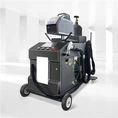
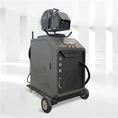

The core advantages of laser welding machines can be summarized in six key technical and operational dimensions, supported by concrete industry applications:
1. High Precision & Minimal Deformation
Laser welding achieves spot diameters as small as 0.1–0.3mm, enabling micro-welding of 0.01mm-thin foils (e.g., lithium battery tabs). The heat-affected zone (HAZ) is reduced to 1/10 that of traditional arc welding, minimizing thermal distortion. For automotive body frames, laser welding reduces deformation by 75% compared to resistance welding, eliminating the need for post-weld correction.
2. Ultra-High-Speed Productivity
A 3kW fiber laser can weld 1mm stainless steel at 20 meters per minute-5 times faster than TIG welding. In power battery module production, fully automated laser lines operate 24/7 with cycle times reduced to 1/3 of conventional methods. For example, Tesla's body-in-white laser welding lines achieve 10-second cycle times for complex joints.
3. Versatility in Material & Structure
Laser welding excels in joining dissimilar metals like steel-aluminum (e.g., EV motor windings) and copper-titanium, the latter critical for aerospace applications. Its 3D scanning capability via galvo systems allows seamless welding of complex surfaces, such as aero-engine blade cooling holes, without mechanical fixtures.
4. Energy Efficiency & Green Operation
Laser systems consume 40–60% less energy than arc welding. A 10kW laser welder in a photovoltaic plant saves over ¥300,000 annually in electricity costs. The process produces 80% less PM2.5 emissions, eliminates spatter, and requires no flux-compliant with ISO 14001 environmental standards.
5. Intelligent Automation Integration
Six-axis robotic arms enable fully automated welding with ±0.02mm positioning accuracy (e.g., Tesla's robotic laser cells). Real-time monitoring via laser vision systems (e.g., Renishaw Equator) boosts yield to >99.5% in high-volume production, reducing manual debugging by 60%.
6. Longevity & Low Maintenance
Fiber lasers have a lifespan exceeding 100,000 hours (11+ years of continuous use), with 70% lower maintenance costs than CO₂ lasers. Self-fusion welding eliminates consumables like filler wire, saving a 3C manufacturer ¥1.2 million annually compared to resistance welding.
Application Spotlight: 3C Electronics
In mobile phone frame sealing, pulsed laser technology with nitrogen shielding ensures IP68-level airtightness and a surface roughness of Ra<1.6-critical for waterproof designs. This reduces rework rates from 12% to <1%, outperforming traditional soldering methods in both quality and throughput.
Each advantage is anchored in technical metrics (e.g., speed, precision) and real-world industrial use cases, emphasizing laser welding's dominance in precision manufacturing and large-scale production.
-----------------------
Ryder