


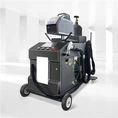
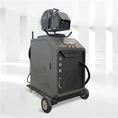
 Pulsed lasers and continuous lasers differ significantly in energy output mode and thermal effect characteristics, leading to distinct application scenarios. The core features and typical applications are explained as follows:
1. Application Scenarios of Pulsed Lasers
Core Characteristics
Typical Applications
Precision Electronic Component Welding
Suitable for sensors, micro-motors, lithium battery tabs, and chip packaging. For example, when welding metal brackets of smartphone camera modules, the pulse energy can be precisely adjusted (e.g., 0.1–10J/pulse) to avoid overheating and damage to components, requiring solder joints with a diameter <0.2mm and no deformation.
Thin Material and Dissimilar Metal Welding
Mainly used for materials with thickness ≤2mm (e.g., 0.1–1mm stainless steel foils, copper sheets) and dissimilar metal combinations (e.g., copper-aluminum, titanium-steel) like welding motor coils in new energy vehicles. The adjustable pulse energy reduces cracks caused by differences in thermal expansion coefficients between materials.
Jewelry and Craftsmanship Processing
Commonly used for spot welding and seam welding of precious metals like gold and platinum. The solder joints are smooth without burrs, eliminating the need for post-grinding, and are suitable for complex shapes (e.g., fine chains, inlays).
Microprocessing and Surface Treatment
Applicable for thin-film circuit cutting, metal surface marking (engraving), and coating removal. Non-contact processing achieves micron-level precision (e.g., semiconductor wafer dicing).
2. Application Scenarios of Continuous Lasers
Core Characteristics
Typical Applications
Automotive Manufacturing and Industrial Mass Production
Suitable for welding body frames (e.g., doors, floor panels), chassis components, and exhaust pipes. For 3–10mm carbon steel/stainless steel or 2–5mm aluminum alloys, welding speeds can reach 1–5m/min, often combined with robots for automated assembly lines.
Thick Plate and Deep Penetration Welding
Capable of processing 10–50mm steel plates and aluminum alloy sheets (e.g., ship decks, pressure vessels), relying on the "keyhole effect" where penetration depth correlates with power (e.g., a 6000W laser can weld 15mm carbon steel). For example, welding high-strength steel in construction machinery arms requires weld strength ≥80% of the base material.
High Thermal Conductivity and High Reflectivity Material Welding
Aimed at materials like pure copper and pure aluminum (requiring high power to overcome surface reflection loss), suitable for welding copper cable joints and aluminum radiator pipes. Continuous energy breaks through material reflection to form a stable molten pool.
Hybrid Welding and Special Processes
Can be combined with arc welding (e.g., laser+MIG/TIG hybrid welding) to improve thick-plate welding efficiency (e.g., single-pass welding of 20mm aluminum alloys). It also supports 3D stereo welding with 5-axis machine tools (e.g., complex curved surfaces of aero-engine blades).
3. Core Differences and Selection Key Points
Power Characteristics: Pulsed lasers typically have an average power of 100–2000W, while continuous lasers offer sustained power from 1000W to 100kW.
Penetration Depth and Speed: Pulsed lasers have a penetration depth usually <1mm and a welding speed of 0.1–1m/min; continuous lasers can achieve a penetration depth of ≥50mm and a speed of 1–10m/min.
Application Focus: Pulsed lasers excel in high-precision, thin-material, or heat-sensitive scenarios; continuous lasers prioritize efficiency, medium-to-thick plate welding, and high-power requirements.
4. Extended Special Scenarios
Pulsed Fiber Lasers: Combining the advantages of pulsed and fiber lasers, suitable for high-speed precision welding of 3C products (e.g., smartphone casings).
Adjustable Pulse Width Lasers: By adjusting the pulse width (e.g., 1–20ms), they balance thin-plate welding with medium penetration needs (e.g., 5mm aluminum alloys).
Continuous CO₂ Lasers: With a wavelength of 10.6μm, they were once used for non-metal materials (e.g., plastics) but are gradually replaced by fiber lasers in metal processing.