


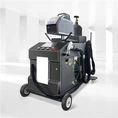
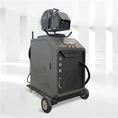

In the field of modern industrial welding, laser welding machines and TIG (Tungsten Inert Gas) welding are two widely used welding technologies. Based on different working principles, they exhibit distinct advantages and disadvantages in practical applications. Understanding these differences is of great significance for selecting suitable welding solutions and improving production efficiency and quality.
1. Welding Efficiency: Laser Welding Offers Faster Speed, While TIG Suits Low-Efficiency Scenarios
In terms of welding efficiency, laser welding machines demonstrate significant advantages. They rely on a high-energy-density laser beam acting on the welding area to quickly melt metal and form a weld. Unlike TIG welding, which requires direct contact between the electrode and the workpiece to transfer heat, laser welding has a more concentrated heat input, resulting in a much faster welding speed than TIG. Especially in mass production or when welding long welds and thin-walled workpieces, laser welding machines can greatly shorten processing time and improve overall production efficiency.
In contrast, TIG welding has relatively dispersed heat transfer and slower welding speed. It is more suitable for scenarios where welding efficiency is not a high priority, such as single-piece small-batch production or precise repair of complex structures. In these scenarios, the production rhythm is slower, and more emphasis is placed on the precise control of welding quality, so the low efficiency of TIG welding does not become a major limiting factor.
2. Weld Quality: Each Has Its Advantages, Adapting to Different Precision Requirements
In terms of weld quality, laser welding machines and TIG welding each have their own characteristics. The laser beam of a laser welding machine has an extremely small focused spot and a narrow heat-affected zone, resulting in minimal thermal deformation of the workpiece after welding. The weld formed is aesthetically pleasing and smooth, and the grain structure of the weld is finer, giving it excellent mechanical properties.
This can effectively reduce the workload of subsequent processes such as grinding and straightening. However, laser welding has higher requirements for the assembly accuracy of workpieces. If the butt gap of the workpiece is too large or there are impurities on the surface, it is easy to cause defects such as incomplete fusion and pores in the weld, requiring thorough pre-treatment of the workpiece in advance.
TIG welding, on the other hand, relies on the good protective effect of inert gas to effectively isolate air and prevent oxidation of the weld, resulting in high weld purity. At the same time, it has a higher tolerance for workpiece assembly accuracy. Even if there are slight gaps or surface irregularities, experienced operators can compensate by adjusting welding parameters (such as current intensity and gas flow).
However, the heat-affected zone of TIG welding is relatively large, making the workpiece prone to deformation after welding, which requires additional straightening treatment. In addition, a certain weld reinforcement may form on the weld surface, requiring subsequent grinding to ensure a smooth appearance.
3. Operation Difficulty: Laser Welding Has High Automation, While TIG Relies on Manual Skills
There is a significant difference between the two in terms of operation difficulty and requirements for operators. Laser welding machines have a high degree of automation, and most equipment is equipped with a precise numerical control system. Operators only need to set parameters (such as laser power, welding speed, and focus position) according to welding requirements, and the equipment can automatically complete the welding process.
This means lower requirements for the technical proficiency of operators. Moreover, the welding process is stable and less affected by human factors (such as hand tremors and changes in operation rhythm), making it suitable for standardized production.
In contrast, TIG welding has extremely high requirements for the technical level of operators. During the welding process, operators need to manually control the moving speed and angle of the welding torch, as well as the wire feed rate. The quality of the weld highly depends on the operator's experience and feel. For example, excessive wire feed speed can easily lead to weld accumulation, while insufficient speed may cause incomplete filling defects.
Novices need long-term training to master proficient welding skills. Furthermore, improper operation by operators during the welding process can easily result in problems such as poor weld formation and undercutting.
4. Application Scenarios: Choose According to Needs to Match Different Industry Requirements
The applicable fields of laser welding machines and TIG welding differ significantly. Laser welding machines are more suitable for fields with high requirements for welding precision and efficiency, such as electronic component welding (requiring extremely small welds and no thermal deformation), medical device manufacturing (with high requirements for weld cleanliness and precision), and precision welding of automotive parts (mass production and high-paced operations).
They are particularly advantageous when welding thin-walled workpieces and small-sized workpieces. Additionally, laser welding can achieve the welding of dissimilar materials (such as metal and ceramics, and metals of different materials), expanding its application range.
TIG welding, on the other hand, is more suitable for scenarios where high weld quality is required but high-speed welding is not necessary, such as stainless steel pipe welding (requiring weld sealing and corrosion resistance), pressure vessel welding (with strict requirements for weld strength and safety), and welding of some components in the aerospace field (requiring high precision but small production batches).
In addition, when welding active metals such as aluminum and magnesium, TIG welding can effectively prevent metal oxidation by virtue of the protective effect of inert gas, avoiding problems such as weld embrittlement and pores. Therefore, it is widely used in the welding of these active metals.
5. Comprehensive Selection: Combine Needs to Balance Effect and Benefit
Overall, laser welding machines and TIG welding each have their unique advantages and disadvantages. There is no "absolutely better" technology, only "more suitable" scenarios. In practical applications, it is necessary to reasonably select the appropriate welding technology based on specific welding requirements (such as precision, speed, and weld strength), workpiece materials (such as active metals, thin-walled workpieces, and dissimilar materials), production batches (such as mass production and custom single-piece production), and quality requirements.
If high efficiency and precision are pursued, laser welding is the preferred choice; if high fault tolerance, welding of active metals, or small-batch precision operations are the focus, TIG welding has more advantages. Only by accurately matching the needs can the best welding effect and economic benefits be achieved.
--Rayther Laser Jack Sun--