


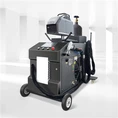
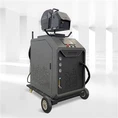
Precautions and Applications of Laser Welding Machine for Aluminum Materials Welding

1.Core Challenges in Aluminum Laser Welding
Aluminum welding with lasers faces three primary obstacles:
High Reflectivity: Aluminum reflects >90% of common near-infrared lasers (1μm wavelength), drastically reducing energy absorption.
Low Boiling Point & High Thermal Conductivity: With a boiling point of 2467°C (lower than steel's 2750°C), aluminum vaporizes easily, causing spatter. Its thermal conductivity (237 W/m·K) is 4× higher than steel, leading to rapid heat dissipation and unstable molten pools.
Oxide Layer and Porosity: The surface Al₂O₃ oxide layer (melting point 2050°C) inhibits fusion, while hydrogen solubility differences between liquid and solid states cause porosity during solidification.
2. Equipment Selection and Process Optimization
Laser Source Selection
Blue Lasers (450nm): Ideal for thin sheets (0.2–3mm), offering >60% absorption.
High-Power Fiber Lasers (1μm): Suitable for medium-thickness plates (3–8mm) with peak power >6kW to suppress reflection instability.
Green Lasers (532nm): Effective for high-reflectivity alloys (e.g., 6061) due to superior oxide penetration.
Note: Blue/green lasers involve higher costs; SMEs may opt for fiber lasers with surface pretreatment.
Critical Process Parameters
Power Control: Use 1–3kW pulsed mode for thin sheets to prevent burn-through; apply ≥4kW continuous wave with beam oscillation (e.g., circular wobble) for thick plates to widen the melt pool.
Pulse Shaping: Square-wave pulses with slow trailing edges minimize spatter. Dual-pulse techniques first break the oxide layer before melting.
Shielding Gas: Helium-Argon mixtures (≥70% He) at 20–30 L/min flow rate. Helium's low density penetrates deeper into the melt pool to expel hydrogen. Position nozzles <5mm from the workpiece.
Surface Pretreatment
Mechanical Cleaning: Scrub with stainless steel wire brushes followed by acetone wiping to remove oxides, boosting absorption by >30%.
Chemical Treatment: Immerse in 10% NaOH for 2 minutes, rinse with water, then passivate with nitric acid to dissolve Al₂O₃.
Absorptive Coatings: Apply carbon black or phosphate layers (<10μm thick) to enhance initial energy coupling.
3.Quality Assurance Techniques
Porosity Mitigation
Reduce travel speed below 3m/min to extend molten pool dwell time for hydrogen escape.
Tilt the laser beam 15°–20° forward to minimize vapor recoil pressure.
Implement post-weld heat treatment (150–200°C for 2 hours) to diffuse trapped hydrogen.
Crack Prevention
Use low-crack-sensitivity filler wires: Al-Si alloys (e.g., ER4047 with 12% Si) or Al-Mg alloys (e.g., ER5356).
Limit heat input to ≤80 J/mm to avoid coarse grain formation.
Real-Time Monitoring
Coaxial vision systems track melt pool dynamics, enabling automatic power adjustments (±5% tolerance).
Plasma sensors detect keyhole instability, triggering parameter compensation.
4.Industrial Application Examples
EV Battery Enclosures (6061 alloy, 2.5mm thick):
Process: 4kW fiber laser + He/Ar gas mix + 0.8mm-diameter beam oscillation.
Result: 1.2:1 depth-to-width ratio, porosity <0.5%, passes IP67 leak test.
Aerospace Fuel Tanks (2219 alloy, 8mm thick):
Process: 2kW blue laser + dual-pulse (pre-pulse for oxide removal, main pulse for welding).
Result: Tensile strength ≥85% of base metal, zero hot cracks.
5.Safety and Maintenance Protocols
Safety: Operators must wear laser safety goggles (OD7+ rating for blue/IR wavelengths). Enclosures require fume extractors to capture toxic Al₂O₃ particulates.
All personnel must obtain the Level 4 Laser Safety Certification, which covers the following contents:
Prediction of aluminum reflection light path (to avoid injury from non-direct light beams)
Emergency shutdown procedure
Maintenance: Clean optical lenses daily with ethanol and lint-free wipes to prevent aluminum vapor deposition. Recalibrate beam alignment monthly (≤0.1mm deviation).
Gas Safety:Helium/argon gas storage tanks are equipped with oxygen concentration sensors (alarm threshold < 19.5% O₂) to prevent asphyxiation caused by the leakage of inert gases.
6. Emerging Technologies
Hybrid Welding: Laser-MIG synergic welding uses MIG arcs to deposit filler metal, compensating for aluminum's solidification shrinkage.
AI-Driven Optimization: Machine learning algorithms analyze melt pool images to predict porosity and auto-adjust parameters.
Cost Reduction: Domestic blue laser power now exceeds 2kW with 40% lower pricing, broadening accessibility.
--Rayther Laser Camila Wang