


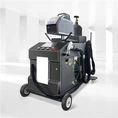
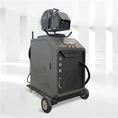

1. Handheld Laser Welding
Overview:
Handheld laser welding machines are portable and flexible, operated manually by the user holding the welding head.
Key Features:
High flexibility, ideal for complex or irregular parts
Easy to operate with minimal setup
Fast deployment, no need for extensive automation systems
Best For:
Small to medium-sized businesses
Custom jobs, small batch production
On-site welding or repairs
Advantages:
Low cost and space-saving
Easy training for operators
Quick changeover for different parts
Limitations:
Operator-dependent consistency
Less suitable for long, repetitive jobs
2. Automated Track-Based Laser Welding
Overview:
In this mode, the welding head moves along a predefined linear or curved track, providing consistent welds.
Key Features:
High welding accuracy and repeatability
Reduced operator involvement
Can be semi-automatic or fully automatic
Best For:
Standardized products
Medium to high production volume
Components requiring consistent quality
Advantages:
Uniform welding results
Improved productivity
Less human error
Limitations:
Requires setup and calibration
Less flexible for highly customized workpieces
3. Robotic Laser Welding
Overview:
Robotic welding uses industrial robots to control the welding path in 3D space, often integrated into fully automated production lines.
Key Features:
Full automation with programmable movements
3D path capability for complex geometries
High efficiency and consistency
Best For:
Mass production
Automotive and electronics manufacturing
High-precision and high-speed operations
Advantages:
Maximum efficiency and precision
Consistent weld quality
Suitable for 24/7 production
Limitations:
High initial investment
Requires technical expertise for setup and programming
Conclusion
Each laser welding operation mode serves different production needs. Handheld systems are ideal for flexibility and small-scale work. Track-based systems offer better consistency for standardized products, while robotic welding is perfect for high-volume, high-precision manufacturing. Understanding these differences helps businesses choose the best setup for their goals.
--Rayther Laser Lyra Zhang