


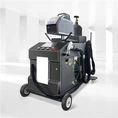
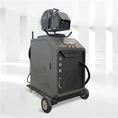

Laser Welding Machine: The Precision Link in Modern Manufacturing
In the current era of rapid technological development, the manufacturing industry is constantly pursuing the integration of high precision, high efficiency, and high quality. The laser welding machine has emerged as a crucial force driving the transformation of various industries. With its unique working principle and excellent performance, it has been widely applied in numerous fields, reshaping the landscape of traditional welding processes.
I. Exploring the Working Principle of the Laser Welding Machine
The laser welding machine, as the name implies, is a device that uses a laser as a heat source to achieve the connection of materials. Its working principle is based on the characteristic of extremely high energy density of the laser beam. The laser generator inside the device produces a high-energy laser beam, which is precisely focused onto the joint of the materials to be welded through a series of optical components such as mirrors and focusing lenses. When the high-energy density laser beam irradiates the surface of the materials, the materials rapidly absorb the laser energy. In a very short period of time (usually in the microsecond or even nanosecond range), the temperature in the irradiated area rises sharply, instantaneously exceeding the melting point of the materials, causing the local melting of the materials. In the liquid state, the originally separated materials blend with each other, and then, under natural cooling or assisted cooling, they solidify rapidly, thus forming a firm welding joint.
During this process, the transfer of laser energy and the interaction with the materials are extremely complex. On the one hand, different materials have significant differences in the absorption rate of the laser. For example, among metal materials, copper, aluminum, etc., have a relatively low absorption rate of the laser, while iron, nickel, etc., have a higher absorption rate. This requires precise adjustment of the laser parameters according to the material characteristics during welding. On the other hand, parameters such as the power density, pulse width, and welding speed of the laser are interrelated and jointly determine the quality and effect of the welding. For instance, a higher power density can achieve a deeper penetration depth, but it may lead to an expansion of the heat-affected zone of the weld. A shorter pulse width is beneficial for reducing the heat-affected zone and is suitable for the welding of heat-sensitive materials.
II. Enumerating the Remarkable Advantages of the Laser Welding Machine
(I) High Precision and High Precision
The laser welding machine can achieve an extremely small weld width and height, with a welding precision reaching the micrometer level. In the field of precision instrument manufacturing, such as the welding of watch movement components, the internal parts are tiny in size and complex in structure. Traditional welding methods are difficult to meet the high-precision requirements. However, the laser welding machine can precisely connect each component, ensuring the stability and accuracy of the movement operation. In the assembly of electronic devices, the welding of integrated circuit pins has an almost demanding requirement for precision. The laser welding machine can achieve a reliable connection by virtue of its high-precision characteristics, greatly improving the performance and stability of electronic products.
(II) High-efficiency Production
The laser welding speed is extremely fast. Take the automotive manufacturing industry as an example. In the body frame welding process, the use of a laser welding machine can significantly shorten the welding time. Traditional resistance spot welding may only be able to complete dozens of welding spots per minute, while the laser welding machine can complete hundreds of welding spots per minute and can achieve continuous welding, greatly improving production efficiency. In addition, the laser welding process is easy to be automated. By integrating with industrial robots and automated production lines, it can operate continuously for 24 hours, further increasing production capacity and reducing production costs.
(III) Excellent Welding Quality
The weld seam formed by laser welding has high strength and good airtightness, and it is not easy to have common welding defects such as pores and cracks. In the aerospace field, the key structural components of aircraft, such as wings and fuselage frames, have extremely high requirements for welding quality. The weld seam welded by the laser welding machine has excellent mechanical properties and can withstand huge stress and load, ensuring flight safety. At the same time, in the food and pharmaceutical packaging industries, the airtightness advantage of laser welding is highlighted, which can effectively prevent product leakage and deterioration and extend the shelf life of products.
(IV) Environmental Protection and Energy Conservation
Compared with traditional welding methods such as arc welding, the laser welding process does not generate harmful gases, strong light radiation, and a large amount of welding spatter, which is friendly to the environment. Moreover, the laser energy is highly concentrated, and the utilization rate is relatively high. There is no need to consume a large amount of electrical energy to maintain a large-area high-temperature environment like traditional welding. While achieving efficient welding, it reduces energy consumption, which is in line with the concept of sustainable development.
III. Gaining Insight into the Diverse Types of Laser Welding Machines
(I) Pulsed Laser Welding Machine
The laser emitted by the pulsed laser welding machine exists in the form of pulses, and the duration of each pulse is extremely short (usually in the range of nanoseconds to milliseconds). This type of welding machine is suitable for the welding of heat-sensitive materials, such as spot welding and seam welding of thin plate materials. In the welding of electronic components, such as the welding of mobile phone camera modules, the pulsed laser welding machine can complete the welding in an instant by precisely controlling the pulse energy and width, reducing the thermal impact on surrounding components and ensuring that the product performance is not damaged.
(II) Continuous Laser Welding Machine
The continuous laser welding machine outputs a continuous and stable laser beam, which can provide a continuous high heat input. It is often used in scenarios where high welding speed and penetration depth are required, such as the body welding of automobiles and the welding of large metal structural parts. In the automobile body-in-white production line, the continuous laser welding machine can quickly weld steel plates of different thicknesses and materials together to form a high-strength body structure, improving the overall safety and lightweight level of the automobile.
(III) Fiber Laser Welding Machine
The fiber laser welding machine uses an optical fiber as the laser transmission medium and has the advantages of good beam quality, low transmission loss, and good flexibility. The optical fiber can flexibly transmit the laser to various welding parts of complex workpieces, making it suitable for welding operations in a three-dimensional space. In the manufacturing of medical devices, for some metal device parts with irregular shapes, such as arthroscopic surgical instruments, the fiber laser welding machine can achieve precise welding by virtue of its flexible transmission characteristics, ensuring the precision and reliability of the instruments.
(IV) Handheld Laser Welding Machine
The handheld laser welding machine is flexible and convenient to operate, getting rid of the space limitations of traditional large-scale welding equipment. It is equipped with a handheld welding gun, and workers can carry out welding on various metal materials on-site according to the actual welding needs. It is suitable for local welding and repair of large workpieces and diversified welding tasks in small processing factories. For example, in a stainless steel door and window processing workshop, workers can use the handheld laser welding machine to weld the door and window frames on-site, improving the processing efficiency and flexibility.
IV. Looking Ahead to the Vast Prospects of the Laser Welding Machine
With the continuous progress of science and technology and the increasing requirements of various industries for product quality and performance, the development prospects of the laser welding machine are very promising. In terms of technological innovation, higher-power and better-beam-quality laser generators will continue to emerge, further improving the welding speed and quality and expanding the range of weldable materials. Intelligent control technology will be deeply integrated into the laser welding machine, enabling it to automatically adjust the welding parameters according to the real-time data during the welding process, realizing adaptive welding and ensuring the stability and consistency of the welding quality.
In terms of the expansion of application fields, the new energy vehicle industry has put forward extremely high requirements for the welding quality and production efficiency of power batteries. The laser welding machine will become a key equipment to ensure the performance and safety of batteries, helping the new energy vehicle industry to develop vigorously. In the semiconductor manufacturing field, with the continuous increase in the integration degree of chips, the requirements for the welding precision of chip packaging, interconnection, and other links have reached the sub-micron or even nanometer level. The laser welding machine is expected to play a greater role in this field by virtue of its high-precision advantages. In addition, in emerging cutting-edge technology fields such as quantum communication and flexible electronics, the laser welding machine will also provide key technical support for the manufacturing of related products due to its unique performance.
--Jack Sun--