


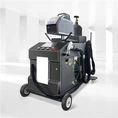
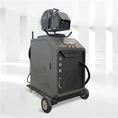

Principle of Laser Cleaning Technology
The principle of laser cleaning technology is based on the interaction between the laser and the material surface. When a high-energy-density laser beam irradiates the rust layer on a metal surface, the rust absorbs the laser energy, rapidly heats up and vaporizes or decomposes. Meanwhile, the generated shockwave separates the rust layer from the metal substrate, achieving the purpose of rust removal. Different from traditional methods, the laser cleaning process does not require the use of chemical reagents, nor does it produce a large amount of dust and wastewater, reducing environmental pollution from the source and conforming to the current development concept of green manufacturing.
Significant Advantages in Practical Applications
High Efficiency: The laser beam can be precisely controlled by a computer to achieve automated operation, capable of quickly treating large-area rust layers. Compared with manual or traditional mechanical cleaning, it greatly improves work efficiency.
Precision: The laser energy can be precisely adjusted to act only on the rust layer without damaging the metal substrate. For some high-precision components with strict surface requirements, such as aero-engine blades and precision molds, laser cleaning is an ideal choice for rust removal.
Wide Applicability: It can effectively remove surface rust from common metals such as steel, aluminum, and copper, as well as special alloy materials.
Additional Advantages of Laser Cleaning Equipment
Laser cleaning equipment also has advantages such as simple operation and reusability. The equipment can be used under different working conditions after simple debugging, reducing labor costs and equipment investment costs. Moreover, the laser cleaning process is non-wearing, and the equipment has a long service life, further enhancing its economic benefits.
Current Applications in Various Fields
Laser cleaning technology has been successfully applied in multiple fields such as aerospace, shipbuilding, automotive industry, and cultural relics protection:
In the aerospace field, laser cleaning is used to remove oxidation layers and coatings from aircraft components, ensuring the performance and safety of the components.
In shipbuilding, it can pre-treat hull steel plates to improve the quality of subsequent painting.
In cultural relics protection, laser cleaning can precisely remove dirt and rust from the surface of cultural relics, protecting the cultural relics themselves to the greatest extent.
Challenges and Development Prospects
Although laser cleaning technology has obvious advantages, it still faces some challenges in the promotion process, such as high initial investment costs for equipment and the need to improve the treatment effect of some complex rust layers. However, with the continuous maturity of technology and the gradual reduction of costs, laser cleaning technology is expected to be widely applied in more fields, become the mainstream technology for industrial rust removal, and play an important role in promoting the green and intelligent development of industrial production.
---Brian---