


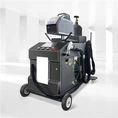

In the application scenarios of laser welding technology, highly reflective materials have become one of the key factors affecting welding effects due to their special interaction with laser energy. These materials possess strong laser reflection characteristics. Compared with ordinary metal materials, when used in conjunction with laser welding machines, they exhibit unique interaction laws in all links from energy transmission to final weld formation, thereby exerting multi-dimensional impacts on welding effects.
1. Direct Influence of Highly Reflective Materials on Laser Energy Utilization Efficiency
The laser reflection characteristic of highly reflective materials first directly affects the energy utilization efficiency during the welding process, which is a fundamental link determining the welding effect. The core principle of a laser welding machine is to emit a laser beam, concentrate energy on the surface of the material to be welded, and cause local melting of the material to achieve connection.
However, highly reflective materials reflect most of the incident laser energy, and only a small amount of energy can be absorbed by the material and converted into thermal energy. This low absorption efficiency makes it difficult for the material surface to reach the expected melting temperature, which not only prolongs the welding preheating time but also may lead to insufficient melting of the material due to insufficient energy supply.
When the melting degree of the material fails to meet the welding requirements, subsequent processes such as molten pool formation and metal fusion will be hindered, ultimately affecting the bonding strength of the weld. In severe cases, problems such as cold welding and incomplete penetration may occur, directly reducing the reliability of the welded joint.
2. Interference of Highly Reflective Materials on the Stable Operation of Laser Welding Machines
In addition to the issue of energy absorption efficiency, the laser energy reflected by highly reflective materials can also interfere with the stable operation of laser welding machines, indirectly affecting the welding effect. The reflected laser energy may act in reverse on the optical system of the laser welding machine, such as key components like focusing lenses and reflective mirrors.
Under long-term exposure to reverse laser energy, the surface coatings of optical components will gradually be damaged, leading to a decline in their optical performance, such as reduced focusing accuracy and changed reflectivity. Changes in the performance of the optical system will further result in uneven energy distribution of the laser beam and deviation of the focusing position.
The originally preset welding parameters can hardly match the actual energy output state. In this case, during the welding process, phenomena such as excessive melting and burn-through of materials due to excessively high local energy, or unstable welding due to excessively low local energy may occur. This undermines the stability of the welding process, causes large fluctuations in weld quality, and makes it difficult to form a uniform and consistent welding effect.
3. Specific Influences of Highly Reflective Materials on Weld Quality
In terms of the specific performance of weld quality, the characteristics of highly reflective materials can also cause a series of special problems. Due to the unstable energy absorption, it is more difficult to form and maintain a molten pool during the welding of highly reflective materials. Fluctuations in the temperature of the molten pool will lead to uneven solidification speed of the metal, thereby causing defects such as pores and cracks in the weld.
Pores are usually generated because the gas in the molten pool cannot escape in a timely manner, and temperature fluctuations will affect the solubility and escape rate of the gas; cracks are related to the stress distribution during material solidification. The uneven solidification process will generate large internal stress inside the weld, and when the stress exceeds the bearing capacity of the material, cracks will form.
In addition, the uneven local heating caused by energy reflection can also affect the appearance formation of the weld. Problems such as uneven weld width, excessive or insufficient reinforcement, and rough surface may occur. This not only reduces the aesthetics of the weld but also may have an adverse impact on the mechanical properties of the weld, such as increasing the risk of stress concentration and weakening the load-bearing capacity of the welded joint.
4. Optimization Directions for Addressing the Influences of Highly Reflective Materials
In response to the influences of highly reflective materials on the welding effect of laser welding machines, the industry has begun to explore various optimization directions to improve welding quality. In terms of equipment improvement of laser welding machines, by developing optical components with anti-reflection functions, the damage of reverse energy to the equipment is reduced.
At the same time, the energy density and stability of the laser beam are enhanced to help highly reflective materials absorb energy more fully. In terms of welding process adjustment, pulse laser welding is adopted instead of continuous laser welding. By controlling the pulse frequency and energy output, precise regulation of the material heating process is realized, reducing energy waste and excessive heating. In addition, pre-treatment is performed on the surface of highly reflective materials, such as grinding, sandblasting, or coating treatment, to change the physical state of the material surface, reduce its reflectivity, and improve the absorption efficiency of laser energy.
The core idea of these measures is to reduce the adverse influences of highly reflective materials. Through the coordinated optimization of equipment and processes, the laser welding effect of highly reflective materials is gradually improved, promoting the further popularization of laser welding technology in the application scenarios of highly reflective materials.
5. Significance of Research on Welding of Highly Reflective Materials for Industry Development
From the perspective of industry development, with the increasing application demands of highly reflective materials in fields such as aerospace, electronic devices, and medical equipment, solving their laser welding problems has become an important direction for the development of laser welding technology.
In-depth research on the influence mechanism of highly reflective materials on the welding effect of laser welding machines can not only provide theoretical support for equipment improvement and process optimization but also promote the extension of laser welding technology to a wider range of material fields, improving the overall welding process level. This meets the demands of different industries for high-precision and high-quality welding and provides technical support for the upgrading and development of related industries.
--Rayther Laser Jack Sun--