


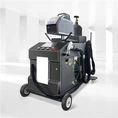


Laser pipe cutters are essential in the pipe processing industry due to their precision, speed, and low waste. To achieve "effective cutting," which ensures precision, smooth edges, stable efficiency, and material conservation, it's crucial to control factors like equipment selection, parameter optimization, material pre-treatment, and operating specifications. The following outlines the key steps for efficient cutting with a laser pipe cutter.
1. Selecting the Right Equipment: The "Basic Premise" for Matching Pipe Characteristics
The first step in effective cutting is to ensure that the configuration of the laser pipe cutter is highly compatible with the material, specifications, and cutting requirements of the pipes to be processed, avoiding the problems of "underpowered equipment" or "equipment overload":
1,Selecting Laser Type Based on Pipe Material
- For metal pipes such as carbon steel and stainless steel: Priority should be given to fiber laser pipe cutters (which have high metal absorption rates and higher cutting efficiency than CO₂ lasers). The power should be selected reasonably according to the pipe thickness;
- For non-metallic pipes such as plastic, glass, and ceramics: CO₂ laser pipe cutters are suitable (as they have good absorption effects on non-metals), avoiding incomplete cutting caused by the high reflectivity of fiber lasers;
- For high-reflectivity metals such as aluminum and copper: Fiber laser pipe cutters with "high-reflection protection functions" (equipped with anti-light reflection devices and special focusing lenses) should be selected to prevent laser reflection from damaging the laser generator.
2,Selecting Equipment Structure Based on Pipe Specifications
- For conventional profiles such as round pipes, square pipes, and rectangular pipes: Choose a "chuck + feeding mechanism" type pipe cutter to ensure that the coaxiality meets standards when the pipe rotates/feeds (avoiding cutting path deviation);
- For special-shaped pipes (such as elliptical pipes and grooved pipes): Equip with "special-shaped clamps + servo positioning systems". Some high-end equipment supports 3D scanning positioning to automatically adapt to the pipe contour;
- For long pipes: It is recommended to select a model with "dual-spindle feeding" to reduce deflection deformation caused by single-end feeding and improve cutting precision.
2. Optimizing Parameters: The "Core Key" for Precise Cutting Control
The precision, speed, and cutting edge quality of laser pipe cutting mainly depend on the rationality of parameter settings. Four core parameters need to be dynamically adjusted according to the pipe material, thickness, and cutting type (drilling, cutting-off, hollowing):
1,Laser Power: Balancing Efficiency and Cutting Edge Quality
- Principle: Use low power for thin pipes (to avoid burning through) and high power for thick pipes (to ensure complete cutting);
- Note: For high-reflectivity pipes (such as copper), the power should be appropriately reduced and combined with a high-frequency pulse mode to reduce cutting edge burrs caused by heat accumulation.
2,Cutting Speed: Matching Power and Pipe Thickness
- Excessively fast speed: Prone to "incomplete cutting" and "cutting edge slag"; Excessively slow speed: Will lead to an expanded heat-affected zone (pipe deformation) and increased material loss;
- Adjustment method: Fine-tuning can be done through the "test cutting method", with the best standard being no burrs on the cutting edge and a flat cross-section.
3,Auxiliary Gas: Selecting the Right Type and Pressure
- For cutting carbon steel: Use oxygen (aids combustion and improves cutting speed), but the oxygen purity must be controlled (low purity easily causes cutting edge oxidation);
- For cutting stainless steel and aluminum: Use nitrogen (prevents oxidation and ensures smooth cutting edges). Especially for precision parts requiring "oxidation-free cutting edges", high-purity nitrogen should be used;
- For cutting non-metallic pipes: Use compressed air (low cost) to avoid gas residue affecting the flatness of the cutting edge.
4,Focal Position: Determining Cutting Depth and Precision
- Focal point on the pipe surface: Suitable for cutting thin pipes, resulting in narrow and smooth cutting edges;
- Focal point inside the pipe: Suitable for cutting thick pipes, ensuring complete cutting and reducing thermal deformation;
- Adjustment method: Use the equipment's "focus test function" and observe the cross-section after test cutting-if the upper part is rough, the focal point is too low; if the lower part is rough, the focal point is too high. Adjust until the cross-section is uniform.
3. Material Pre-treatment: The "Necessary Step" for Reducing Cutting Errors
The "initial state" of the pipe itself directly affects the cutting effect. Three pre-treatment steps should be completed before processing:
1,Pipe Straightening: Eliminating Bending Deformation
- For pipes that are bent after storage (especially long pipes), first use a "pipe straightening machine" for treatment to ensure that the straightness meets standards (bent pipes will cause feeding deviation and increase cutting size errors);
- After straightening, measure the pipe diameter/side length to ensure that the tolerance is within the equipment's adaptation range, and remove pipes with excessive tolerances.
2,Surface Cleaning: Removing Impurity Interference
- For metal pipes: Wipe off surface oil stains and oxide layers with alcohol or acetone (oil stains will cause smoke during cutting, and oxide layers will reduce laser absorption rate, resulting in "cutting breakpoints");
- For non-metallic pipes (such as PVC): Remove surface dust and stickers (dust will cause laser scattering, and burned stickers will easily block the nozzle).
3,Pipe Fixing: Avoiding Displacement During Cutting
- Select special clamps according to the pipe shape: Use "V-shaped clamps" for round pipes and "square positioning clamps" for square pipes. Soft rubber should be padded at the contact between the clamp and the pipe (to prevent scratching the pipe surface);
- After fixing, check the "coaxiality": Start the equipment to rotate the pipe without load, and use a dial indicator to measure the pipe's outer circle runout to ensure that the runout meets standards (if the runout is too large, re-adjust the clamp).
4. Operating Specifications: The "Important Guarantee" for Stable Operation
Even if the equipment and parameters are compatible, non-standard operations can still lead to cutting failure. Three core specifications must be strictly followed:
1,Pre-start Inspection: Eliminating Equipment Hidden Dangers
Check three key items before starting the machine daily: ① Laser cooling system (normal water temperature, water level up to standard, no turbidity in the coolant); ② Auxiliary gas pressure (meets cutting requirements, no air leakage in the gas pipe); ③ Nozzle status (no blockage, no damage, and the nozzle aperture matches the pipe thickness).
2,In-cut Monitoring: Timely Adjustment for Abnormalities
Observe the cutting process in real-time: ① If "cutting edge slag" occurs, appropriately increase the gas pressure or reduce the cutting speed; ② If "cutting path deviation" occurs, pause to check the pipe fixing status (whether it is loose) or the feeding mechanism precision (whether calibration is needed); ③ If the laser alarms, stop the machine immediately for troubleshooting (common causes: excessive water temperature, insufficient gas, blocked nozzle).
3,Post-cut Maintenance: Extending Equipment Service Life
After each cutting operation: ① Clean the waste and residues on the workbench (to prevent accumulation from affecting the next positioning); ② Blow and clean the nozzle and focusing lens with compressed air (to avoid residue adhesion causing laser scattering); ③ Regularly apply lubricating oil to moving parts such as the feeding guide rail and chuck (to ensure stable feeding precision).
5. Software Support: The "Technical Empowerment" for Improving Cutting Efficiency
The "software system" of the laser pipe cutter is the "brain" for parameter control and path optimization. Rational use of software functions can further improve cutting effectiveness:
1,Path Optimization: Reducing Idle Time
- Use the software's "nesting layout" function: When cutting multiple short pipes, automatically optimize the cutting sequence (avoiding repeated feeding) to reduce idle time;
- Select the "common-edge cutting" mode: For batches of pipes with the same specifications, adjacent cutting edges share a single laser path to reduce repeated drilling (drilling time accounts for a certain proportion of the total cutting time).
2,Parameter Storage: Realizing Standardized Cutting
- For commonly used pipes, after debugging the cutting parameters, store them as templates through the software's "parameter saving" function for direct use in the next processing (avoiding repeated test cutting and saving time);
- For new types of pipes, use the software's "parameter recommendation" function (some high-end equipment has a built-in material database) to automatically generate initial parameters based on pipe characteristics, and then perform fine-tuning through test cutting (reducing debugging difficulty).
6. Troubleshooting Common Problems: Quickly Restoring Effective Cutting
Even if the above steps are well implemented, problems may still occur during cutting. It is necessary to master the solutions to three common problems:
1,Burrs on the Cutting Edge
- Causes: Insufficient gas pressure, excessively fast cutting speed, deviated focal position;
- Solution: Appropriately increase the gas pressure, reduce the cutting speed, and re-calibrate the focal position.
2,Large Cutting Size Error
- Causes: Pipe bending, deviated feeding precision, loose clamp;
- Solution: Re-straighten the pipe, adjust the feeding mechanism using the "feeding calibration function" (built into the software), fasten the clamp, and check the coaxiality.
3,Decreased Laser Power
- Causes: Cooling system failure, contaminated focusing lens, laser aging;
- Solution: Check the cooling water temperature (clean the water tank filter if necessary), wipe the focusing lens with a special cleaning agent (avoid scratching the coating), and if the power decreases significantly, contact the manufacturer for laser maintenance.
7.Conclusion
The "effective cutting" of a laser pipe cutter is not determined by a single link, but a systematic project encompassing "equipment selection-parameter optimization-material pre-treatment-operating specifications-software empowerment-problem solving".
In practical applications, it is necessary to dynamically adjust the details of each link in combination with pipe characteristics and processing requirements, while focusing on daily equipment maintenance and operator training.
Through scientific management and control, the laser pipe cutter can achieve "precision meeting standards, no burrs on cutting edges, stable efficiency, and material conservation", truly exerting the technical advantages of laser cutting.
--Rayther Laser Jack Sun--