


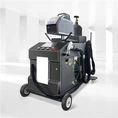
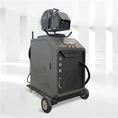

I. Working Principles of Fiber Laser Cutting Machines
The working principle of a fiber laser cutting machine is based on light amplification by stimulated emission (LASER). Its core component is the fiber laser, with the gain medium being optical fibers doped with rare earth elements (such as ytterbium Yb, erbium Er, etc.). Through a pump source (typically a semiconductor laser), light of a specific wavelength is emitted to inject energy into the gain medium, causing rare earth ions in the fiber to transition from low energy levels to high energy levels, forming a population inversion distribution. When a suitable photon enters, ions in the high energy level undergo stimulated emission to produce photons with the same frequency, phase, and direction as the incident photon. These photons continuously reflect and amplify within the fiber resonator, eventually outputting a laser beam with high energy density and high directivity.
The laser beam is transmitted through an optical fiber to the cutting head, focused by a focusing lens, and irradiated onto the surface of the metal workpiece. In an instant, the laser energy is absorbed by the material, rapidly heating the irradiated area to its melting point or even boiling point, causing melting and vaporization. At the same time, auxiliary gases (such as oxygen, nitrogen, etc.) are blown into the cutting area at high speed through the nozzle of the cutting head, blowing away the melted and vaporized material from the slit, thus achieving material cutting.
II. Composition of Core Technologies
1. Fiber Laser Technology
Pump Technology: Currently, fiber-coupled semiconductor pumping technology is widely used, which can efficiently couple the light output by the semiconductor laser into the optical fiber to provide energy for the gain medium. The power, stability, and coupling efficiency of the pump light directly determine the output power and performance stability of the fiber laser. For example, multi-mode pumping technology can effectively increase the injection power of pump light to achieve higher-power laser output, meeting the high-energy requirements of thick plate cutting.
Gain Medium: Ytterbium-doped fiber has become the mainstream gain medium for high-power fiber lasers due to its wide gain bandwidth, high quantum efficiency, and good thermal stability. By optimizing the doping concentration and fiber structure, the gain effect can be further enhanced, improving the laser output power and beam quality. For instance, using a double-clad structure of ytterbium-doped fiber can increase the interaction length between the pump light and the gain medium, improving pumping efficiency.
Resonator Design: The resonator determines the laser oscillation mode and beam quality. A common type is the all-fiber resonator, which uses optical elements such as fiber Bragg gratings to form a feedback loop. Parameters of the fiber Bragg grating, such as reflectivity and bandwidth, significantly affect the resonator's performance. Through precise design and fabrication of fiber Bragg gratings, single-mode oscillation can be achieved, outputting a high-quality laser beam to meet the strict requirements of precision machining for beam quality.
2.CNC System and Cutting Control Technology
CNC System: As the "brain" of the fiber laser cutting machine, the CNC system is responsible for interpreting processing instructions and precisely controlling the movement trajectory of the cutting head and laser parameters. Advanced CNC systems have high-speed computing capabilities to achieve rapid processing and real-time control of complex graphics. For example, when machining the complex contours of automotive parts, the CNC system can accurately control the cutting head's position according to the preset program to ensure cutting precision and quality.
Cutting Parameter Control: For different materials and processing requirements, parameters such as laser power, cutting speed, and auxiliary gas pressure need to be precisely controlled. Through an intelligent control system, the optimal cutting parameters can be automatically matched according to the material thickness and type. For instance, when cutting thin stainless steel plates, reducing the laser power and increasing the cutting speed can effectively reduce the heat-affected zone and ensure cutting quality; when cutting thick plates, increasing the laser power and auxiliary gas pressure is required to ensure the material is cut through.
Real-time Monitoring and Feedback: To ensure the stability and reliability of the cutting process, the cutting machine is equipped with multiple sensors to real-time monitor the cutting status, such as the distance between the cutting head and the workpiece, laser power fluctuations, and slit width. Once an abnormality is detected, the system will promptly adjust parameters or issue an alarm to avoid processing defects. For example, when detecting a change in the distance between the cutting head and the workpiece, the automatic focusing system will respond quickly to ensure the laser always focuses on the workpiece surface, maintaining stable cutting performance.
3. Optical Transmission and Focusing Technology
Optical Fiber Transmission: The optical fiber is a key component for laser transmission, featuring low loss and good flexibility to efficiently transmit the laser to the cutting head. The research and development of special optical fibers have further improved the power-carrying capacity and transmission efficiency of optical fibers. For example, large-mode-area optical fibers can transmit higher-power lasers, reducing the impact of nonlinear effects and ensuring the stability of laser transmission and beam quality.
Focusing System: The focusing system consists of optical elements such as focusing lenses and mirrors, whose role is to focus the laser beam onto the workpiece surface to form a 极小的 (minuscule) spot and increase energy density. The design and manufacturing precision of the focusing system are crucial to cutting quality. A high-precision focusing lens can achieve precise focusing of the spot, reduce the spot size, and improve cutting precision and efficiency. Meanwhile, the automatic focusing technology can real-time adjust the focusing position according to changes in workpiece thickness, ensuring the spot is always in the optimal focusing state during the cutting process.
III. Application Fields and Cases
1.Automotive Manufacturing Industry
In automotive component manufacturing, fiber laser cutting machines are widely used in processing body structural parts, engine components, interior parts, etc. For example, when cutting high-strength steel frames of vehicle bodies, the high precision and speed of fiber laser cutting machines can achieve accurate cutting of complex shapes, improving the assembly precision and overall strength of the body. Meanwhile, for aluminum alloy engine blocks, cylinder heads, and other components, fiber laser cutting can avoid deformation problems caused by traditional processing methods, ensuring the dimensional accuracy and performance requirements of components.
2. Aerospace Field
The aerospace field has extremely high requirements for the processing precision and quality of components. Fiber laser cutting machines can be used for processing difficult-to-machine materials such as titanium alloys and nickel-based alloys to manufacture key components like aircraft wing skins, engine blades, and aircraft engine casings. When processing aircraft engine blades, using the five-axis 联动 (linkage) function of fiber laser cutting machines can achieve precise machining of complex curved surfaces to meet the aerodynamic performance requirements of blades.
3. Electronics and Electrical Industry
In the manufacturing of electronic and electrical products, fiber laser cutting machines are commonly used for processing precision components such as mobile phone casings, computer heat sinks, and electronic components. Taking the processing of mobile phone casings as an example, fiber laser cutting machines can achieve high-precision cutting of ultra-thin metal sheets, with smooth and burr-free cutting edges, eliminating the need for subsequent secondary processing and greatly improving production efficiency and product quality.
4. Mechanical Manufacturing Industry
In the mechanical manufacturing industry, fiber laser cutting machines are used for processing various mechanical parts such as gears, shaft parts, and molds. For processing complex-shaped molds, fiber laser cutting machines can achieve high-precision cutting and engraving according to the 3D design model of the mold, shortening the mold manufacturing cycle and improving the manufacturing precision and service life of the mold.
Fiber laser cutting machines have demonstrated strong processing capabilities and application potential in numerous industries by virtue of their unique core technologies. With the continuous innovation and development of technology, their performance will continue to improve, and their application fields will further expand, injecting new vitality into the high-quality development of modern manufacturing.
---Brian---