


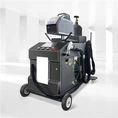
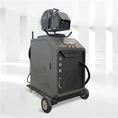

I. Classification by Laser Type
1. Fiber Laser Welding Machine
Technical Features: Utilizes fiber-optic conduction for laser beams, boasting excellent beam quality (M²<1.5) and a photoelectric conversion rate of over 30%, consuming only 1/3 of the energy of traditional YAG lasers. The spot diameter can be precisely controlled between 0.1-0.6mm, with a weld depth-to-width ratio of up to 5:1 or more, making it particularly suitable for welding 0.1-5mm thin plates.
Application Advantages:
Compact size (only 1/5 the volume of CO₂ lasers) and long-distance transmission via fiber (up to 200 meters), facilitating integration into robotic workstations.
Supports 24-hour continuous stable operation with low maintenance costs (annual maintenance fees 60% lower than CO₂ lasers), ideal for mass production in automotive parts, 3C electronics, etc.
Case Example: Haiwei Laser's fiber continuous welding machine achieves a welding speed of 200mm/min in new energy battery module welding, with weld tensile strength reaching 95% of the base material.
2. CO₂ Laser Welding Machine
Technical Features: Emits at a wavelength of 10.6μm, with high absorption by non-metallic materials, enabling deep penetration welding (penetration depth up to 20mm). Cross-flow CO₂ lasers can reach 30kW power, suitable for welding 10mm+ thick plates; axial fast-flow types excel in high beam quality (TEM00 spot mode) for precision welding.
Application Limitations:
Bulky equipment (footprint exceeding 10m²) requiring complex water cooling systems, with initial investment 40% higher than fiber lasers.
High reflectivity of metal materials (e.g., aluminum reflectivity >90%), necessitating surface pretreatment to improve absorption, increasing process complexity.
Typical Scenarios: Automotive white body 拼焊 (e.g., WISCO uses 8kW cross-flow CO₂ lasers for 6mm steel plates), aerospace titanium alloy structural component welding.
3. Disc Laser Welding Machine
Technical Features: Adopts a disc-shaped gain medium, with a heat dissipation area 10 times larger than traditional rod lasers, enabling ultra-high power output of 24kW and beam quality (BPP) ≤4mm·mrad. Green wavelength models (515nm) solve splash issues in copper welding, increasing weld tensile strength by 30%.
Application Breakthroughs:
Achieves 3mm penetration in copper busbar welding, 50% faster than traditional fiber lasers, applied in new energy vehicle battery pack connections.
Supports ultrashort pulse (picosecond/femtosecond) processing for micro-nano precision welding, suitable for medical catheters, MEMS devices, etc.
II. Classification by Welding Mode
1. Continuous Laser Welding Machine
Process Characteristics: Energy density ≥10⁶W/cm², weld depth-to-width ratio up to 10:1, suitable for medium-thick plates (3-20mm). In automotive body structure welding, the speed reaches 5m/min, 3 times faster than traditional arc welding.
Technical Limitations: High heat input prone to porosity in aluminum alloy welding (porosity rate up to 5%), requiring improvement via filler wire addition or dual-beam technology.
2. Pulsed Laser Welding Machine
Process Advantages: Peak power up to 10⁸W, pulse width 5-20ms, suitable for spot welding 0.05-2mm thin plates. In electronic component welding, the heat-affected zone ≤0.2mm avoids chip overheating damage.
Efficiency Bottleneck: Slower welding speed (50-100 spots/min), 20% higher equipment cost than continuous types, mainly used in small-batch precision processing for medical devices, jewelry, etc.
III. Classification by Application Function
1. Handheld Laser Welding Machine
Flexibility Design:
Gun head weight <1.5kg, supporting 360° arbitrary-angle welding, ideal for on-site repair of large outdoor components (e.g., bridges, pressure vessels).
Integrated laser cleaning function (50-200W power) removes surface oxides before welding, reducing porosity to <1%.
Technical Innovation: Han's Yueming's three-in-one handheld machine integrates welding, cleaning, and marking functions, with parameter presetting via touchscreen, allowing ordinary workers to operate within 1 hour.
2. Robot Laser Welding Machine
Intelligent Features:
Equipped with vision guidance system (accuracy ±0.05mm) for automatic weld position recognition and path adaptive adjustment in complex curved surface welding.
Real-time data monitoring records over 20 parameters (welding current, temperature, etc.) for quality traceability and process optimization, increasing yield to 99.5%.
Typical Application: Tesla's Shanghai factory uses KUKA robot laser welding machines to achieve fully automatic welding of 7,000+ spots on Model 3 bodies, shortening the production cycle to 3 minutes/unit.
IV. Special Scenario-Dedicated Models
1. Laser Mold Brazing Machine
Repair Precision:
Spot diameter 0.2-2mm, welding depth 0.1-3mm, repairing minor defects (sand holes, chipping) in molds, with post-repair surface roughness Ra≤0.8μm.
Non-contact welding ensures heat-affected zone ≤0.5mm, avoiding precision mold deformation (deformation <0.01mm).
Material Compatibility: Supports mold steels (S136, H13) and beryllium copper, red copper, etc., with repaired molds lasting 80% of new ones.
2. Sensor Laser Welding Machine
Sealing Performance:
Pulsed laser hermetic welding with weld width 0.1-0.3mm and airtightness up to 1×10⁻⁹Pa·m³/s, meeting sealing requirements for underwater sensors (1,000m water depth).
Workpiece temperature rise <5℃ during welding prevents performance drift of internal sensor components (e.g., MEMS chips).
Process Validation: Jinmi Laser's WS series equipment achieves welding strength ≥90% of the base material and a defect rate <0.1% in temperature sensor welding.
V. Technical Trends and Selection Suggestions
Intelligent Upgrades: New-generation laser welding machines commonly integrate AI algorithms. For example, Trumpf's TruDisk lasers predict molten pool status via machine learning and automatically adjust power parameters, reducing manual debugging time by 40%.
Green Manufacturing: Fiber lasers consume 60% less energy than CO₂ lasers and require no protective gases (He, N₂), lowering comprehensive operation costs by 30%.
Key Selection Points:
Thick plate welding (>5mm): Prioritize CO₂ or disc lasers for balanced penetration and cost.
Precision processing (<0.5mm): Pulsed fiber laser welding machines are preferred to ensure low heat impact.
Automated production lines: Robot laser welding machines with vision systems enable full-process unmanned operation, enhancing production stability.