


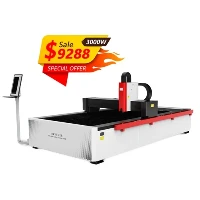
In the global metal fabrication and heavy industry sectors, time is money, and thickness determines your market capability. Driven by the relentless pursuit of efficiency, high-power fiber laser cutting machines (12kW to 40kW+) have transitioned from mere concepts into the ultimate productivity workhorses for steel structures, heavy machinery, shipbuilding, and rolling stock manufacturing.
If you are considering a workshop upgrade, the following three dimensions reveal how ultra-high-power laser technology completely revolutionizes traditional heavy-duty fabrication.

1. Breaking the Thickness & Speed Bottlenecks of Medium-to-Thick Plates
In the past, processing carbon steel or stainless steel thicker than 20mm forced factories to rely on slow, rough flame or plasma cutting. The advent of ultra-high power fiber lasers completely smashes this limitation.
Extreme Thickness Capabilities:
Fiber lasers running at 20kW to 40kW effortlessly pierce ultra-thick plates ranging from 50mm-100mm. Whether it is massive stainless steel flanges or heavy structural components for construction machinery, the machine handles it in one single pass.
Exponentially Accelerated Speed:
When cutting common 10mm-20mm medium plates, a 20kW system runs several times faster than a standard 6kW machine. This massive boost in throughput grants your factory an unbeatable delivery advantage when handling large-volume, urgent contracts.
2. Flawless Cut Quality: Eliminating Costly Secondary Operations
When evaluating global suppliers, procurement directors in heavy industries look beyond raw speed; they heavily prioritize surface cut quality.
(The Defect of Traditional Plasma:Traditional plasma cutting leaves heavy bevel angles and rock-hard dross on thick plate edges. Workers must spend hours grinding and milling manually, dragging down the workshop's overall turnover efficiency.
The Leap of High-Power Smart Process:Utilizing high-power lasers paired with high-pressure air cutting or next-gen nozzle technologies, even plates tens of millimeters thick achieve near-vertical cuts with smooth, carbon-free surfaces and zero dross. This means components lifted from the unloading area can go directly to the welding station, saving immense labor costs.
3. The True ROI Behind High-Ticket Machinery: Hidden Profits in High Output
Many business owners are hesitant when facing the high initial price tag of ultra-high-power laser machines. However, looking through the lens of long-term Total Cost of Ownership (TCO), its ROI is actually significantly higher.
Lower Cost Per Part: Although high-power models draw more power and gas per hour, because their processing speed scales up exponentially, the combined electricity, labor, and depreciation costs allocated to a single finished part drop drastically.
Expanding Your Business Moat: Low-power equipment traps your shop in endless price wars within the thin sheet market. Transitioning to high-power cutting unlocks elite, high-margin sectors like rail transit, heavy mining machinery, and massive wind-turbine bases, building a competitive moat that standard workshops cannot breach.

Conclusion: Your Foundation for Future Heavy Manufacturing
A high-power fiber laser cutter is far more than a piece of machinery; it is an essential springboard for factories transitioning into large-scale, smart, and high-end manufacturing. In an era where speed and precision dictate business survival, adopting high-power technology early positions your company at the peak of market profitability.
Need a Customized High-Power Configuration? Choosing between 12kW, 20kW, 30kW, or 40kW depends strictly on your production volume and maximum plate thickness. We manufacture heavy-duty, ultra-high-power laser cutters with reinforced machine beds built for stable 24/7 operations. Contact our engineering team today with your material specs for a personalized ROI report and an optimal quotation!