


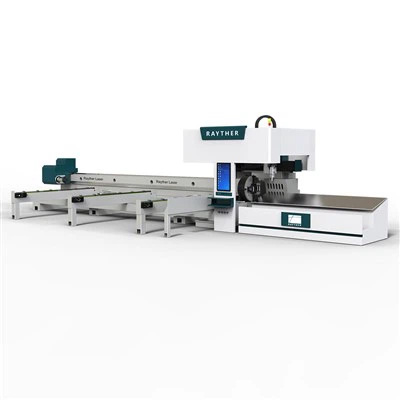
The bevel cutting function of laser pipe cutting machines is a key technology for achieving high-precision, high-efficiency bevel cutting in modern pipe processing. Its working principle integrates laser energy control, mechanical motion precision, and intelligent algorithms, enabling the cutting of bevels with specific angles (such as V-shaped, U-shaped, etc.) on the pipe surface to meet the interface precision requirements of subsequent processes like welding and splicing. The following is a detailed analysis from the core principles and key technical links:
1. Energy Focusing of Laser Beam and Material Ablation
The core of bevel cutting in laser pipe cutting machines lies in using a high-energy-density laser beam as a "cutting tool." The equipment generates laser light of a specific wavelength (usually fiber laser with a wavelength of approximately 1064nm) through a laser generator. After being focused by the optical path system (including reflectors, focusing lenses, etc.), it forms a high-energy light spot with an extremely small diameter (typically 0.1-0.3mm). When the light spot irradiates the pipe surface, light energy is instantly converted into heat energy, causing the material on the pipe surface to rapidly heat up to the melting point or even boiling point, achieving local melting or gasification.
In bevel cutting, the energy density of the laser beam must be precisely adjusted according to the pipe material (such as carbon steel, stainless steel, aluminum alloy, etc.) and bevel angle. For example, when cutting large-angle bevels on thick-walled pipes, the laser power needs to be increased to ensure sufficient ablation of the material; while for small-angle bevel cutting on thin-walled pipes, the power should be reduced to avoid excessive burning through or deformation. Meanwhile, auxiliary gases (such as oxygen, nitrogen) are used during the cutting process. Oxygen can support combustion and accelerate material oxidation and melting, while nitrogen is used to protect the cut from oxidation, ensuring a smooth, burr-free bevel surface.
2. Precise Positioning and Clamping of Pipes
To achieve precise bevel cutting, pipes must first be stably clamped and accurately positioned. Laser pipe cutting machines are usually equipped with multiple sets of pneumatic or hydraulic chucks, which fix the pipe on the cutting station through adjustable fixtures to ensure no shaking or displacement during cutting. At the same time, the equipment detects the pipe's diameter, length, and center position through sensors (such as photoelectric sensors, encoders) and feeds the data back to the control system, providing basic parameters for subsequent cutting path planning.
For bevel cutting of special-shaped pipes (such as square pipes, rectangular pipes, elliptical pipes), the positioning system must also identify the cross-sectional shape of the pipe to ensure that the starting point of the laser beam aligns with the reference surface of the pipe, avoiding bevel angle errors caused by positioning deviations.
3. Angle Adjustment of the Cutting Head and Trajectory Control
The biggest difference between bevel cutting and ordinary vertical cutting is that the cutting head must have angle adjustment functionality. The cutting head of a laser pipe cutting machine is usually mounted on a multi-axis linkage robotic arm or a CNC workbench, enabling translation along the X, Y, and Z axes, as well as rotation around the A-axis (rotation angle) and B-axis (swing angle). During bevel cutting, the control system drives the cutting head to rotate around the pipe axis or cutting point according to the preset bevel angle (such as 30°, 45°, 60°, etc.), making the laser beam form a specific angle with the pipe surface.
Meanwhile, the CNC system automatically calculates the cutting trajectory based on the pipe's diameter, wall thickness, and bevel angle. For example, when cutting a V-shaped bevel on a circular pipe, the cutting head must move along the pipe's axial direction while synchronously making a circular motion around the pipe's periphery to ensure the bevel angle remains consistent throughout the circumference. For bevel cutting at the end of a straight pipe, trajectory control must ensure that the cutting surface forms a preset angle with the pipe axis, with a flat and non-inclined cut.
4. Collaborative Operation of the Intelligent Control System
Bevel cutting in laser pipe cutting machines is a dynamic collaborative process of "laser energy - mechanical motion - material response," which is fully regulated by an intelligent control system. The system's built-in cutting database stores laser parameters (power, frequency, pulse width), movement speed, auxiliary gas pressure, and other data corresponding to pipes of different materials and specifications. Operators only need to input information such as bevel angle and pipe parameters, and the system will automatically match the optimal parameters.
During cutting, sensors real-time monitor the temperature of the cutting area, slag splashing, and other conditions. If abnormalities occur (such as incomplete material cutting, bevel angle deviation), the system will immediately adjust the laser power or movement speed to achieve closed-loop control. For example, when burrs are detected on the bevel surface, the system will automatically increase the laser power or reduce the cutting speed to ensure the quality of the cut. In addition, some high-end equipment supports 3D simulation functions, which can simulate the bevel cutting process before cutting to pre-check trajectory conflicts or parameter errors, further improving cutting precision and efficiency.
5. Advantages and Application Scenarios of Bevel Cutting
Based on the above working principles, bevel cutting with laser pipe cutting machines has multiple advantages: First, the high focusing property of the laser beam ensures that the bevel angle error can be controlled within ±0.5°, meeting the requirements of high-precision welding for interfaces; second, non-contact cutting avoids friction between mechanical tools and pipes, reducing pipe deformation and tool wear; third, the cutting efficiency is high. For stainless steel pipes with a diameter of 100mm, the cutting speed of 45° bevels can reach 1-2 meters per minute, which is much higher than traditional mechanical cutting.
This technology is widely used in fields such as petrochemicals, machinery manufacturing, and steel structures. For example, in pipeline engineering, bevel cutting makes the pipe interfaces form precise welding angles, which can greatly improve welding strength and sealing; in automobile frame processing, bevel cutting of special-shaped pipes enables seamless splicing of components, reducing the overall weight while ensuring structural stability.
--Rayther Laser Jack Sun--