


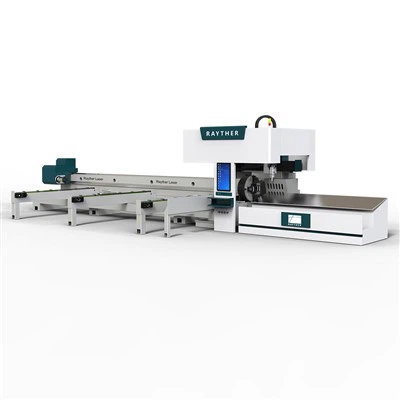
Laser tube cutting machines are highly versatile and can process a wide range of metal tubes with precision and efficiency. Here are the most common suitable materials:
1. Carbon Steel (e.g., Q235, 20# Steel)
Best for: Structural, automotive, and machinery applications.
Advantages: Clean cuts, fast speed, low cost.
Note: High-carbon steel (e.g., 45#) may require parameter adjustments to prevent cracking.
2. Stainless Steel (304, 316, etc.)
Best for: Food, medical, and chemical industries.
Advantages: Oxidation-free cuts, smooth edges, retains corrosion resistance.
Note: Requires nitrogen assist gas for optimal results.
3. Aluminum & Aluminum Alloys (e.g., 6061, 6063)
Best for: Automotive, aerospace, and electronics.
Advantages: Minimal deformation, high precision.
Note: Needs high-power fiber lasers (≥2000W) and nitrogen/argon shielding due to reflectivity.
4. Copper & Brass (Red Copper, H62, etc.)
Best for: Electrical and decorative applications.
Challenges: High reflectivity requires infrared lasers (fiber lasers).
Note: Anti-reflection protection is necessary for stable cutting.
5. Titanium Alloys (e.g., Ti6Al4V)
Best for: Aerospace and medical implants.
Advantages: Clean cuts under inert gas (argon) protection.
Note: Requires a sealed environment to prevent oxidation.
Other Suitable Materials
Galvanized Steel: Needs proper settings to avoid zinc vapor contamination.
Nickel Alloys (Inconel): Requires high power and gas shielding.
Materials to Avoid or Use with Caution
Non-metals (PVC, rubber): CO₂ lasers are better suited.
Highly reflective metals (pure copper, gold): Special laser sources needed.
Very thick-walled tubes: Plasma or flame cutting may be more efficient beyond certain thicknesses.
Key Selection Factors
Tube dimensions: Diameter (20–600mm typical), wall thickness (affects laser power).
Laser power: 500–1000W for thin tubes, 2000–6000W for thick materials.
Assist gas: Oxygen (carbon steel), nitrogen (stainless steel, aluminum), air (low-cost option).
Laser tube cutting is ideal for industries like automotive, construction, furniture, and energy due to its speed, precision, and flexibility. Proper material and parameter selection ensure optimal results.
---------Victor Feng
Rayther Laser