


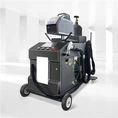
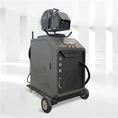

Here's a comparison between continuous wave (CW) laser welding machines and pulsed laser welding machines in English:
1. Laser Output Mode
CW Laser Welder:
Emits a continuous, steady beam of laser energy, enabling uninterrupted melting for long seams or high-speed welding.
Pulsed Laser Welder:
Delivers laser energy in short, high-power pulses (millisecond/microsecond/nanosecond durations), creating intermittent melt pools. Ideal for spot welding or fine seams.
2. Heat Input & Control
CW Laser:
High, concentrated heat input → Larger heat-affected zone (HAZ) and potential distortion.
Best for thermally conductive materials (e.g., aluminum, copper) or thick plates.
Pulsed Laser:
Peak power is high, but average power is low → Minimal heat accumulation, smaller HAZ.
Precise control over pulse energy/duration → Reduces thermal damage to thin/heat-sensitive materials (e.g., stainless steel, titanium).
3. Speed & Efficiency
CW Laser:
Faster (up to meters per minute), suitable for mass production (e.g., automotive panels).
Pulsed Laser:
Slower (sequential pulsing) but offers higher precision (e.g., micro-welding electronics).
4. Material Compatibility
CW Laser:
Optimal for medium-to-thick materials (1–10 mm), including reflective metals (requires high power to overcome reflectivity).
Pulsed Laser:
Designed for thin materials (<1 mm) or dissimilar metals (e.g., copper-aluminum joints), preventing burn-through.
5. Typical Applications
CW Laser:
Automotive body welding, battery sealing, aerospace structural components.
Pulsed Laser:
Electronics (PCB, sensors), medical devices, jewelry, precision tool repair.
6. Cost & Maintenance
CW Laser:
Higher power (kilowatt-level), higher equipment/energy costs, but more productive.
Pulsed Laser
Lower average power, generally cheaper, but optics require careful maintenance (pulse frequency affects lifespan).
How to Choose?
Use CW Laser: For speed, thick materials, or long seams.
Use Pulsed Laser: For precision, thin/heat-sensitive materials, or micro-welding.
Note: Some high-power pulsed lasers (e.g., ms pulses) can weld thicker materials but at increased cost.
-------Victor Feng
Rayther Laser