


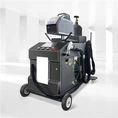
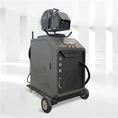

1. Power Supply Requirements
Power Type: A 380V three-phase five-wire industrial power supply is required (some low-power models may support 220V single-phase power; refer to the equipment manual for details).
Capacity Matching: Select the transformer capacity based on the equipment power:
1500W model: Requires ≥20kW power capacity;
3000W model: Requires ≥40kW power capacity;
6000W and higher models: Requires ≥80kW power capacity (high-power equipment needs a dedicated transformer to avoid sharing lines with other high-power devices).
Cable Specifications: Use copper-core main cables. The wire diameter is calculated based on current (e.g., a 6000W model with a current of ~100A requires ≥25mm² copper cables) and must be equipped with overload protection switches.
2. Environmental Conditions
Temperature Control: The operating environment temperature must be maintained at 15-35°C (prevent water-cooling fluid from freezing in winter and use air conditioners or industrial fans for cooling in summer).
Humidity Requirements: Relative humidity ≤70%RH (avoid short circuits in electrical components due to moisture) and no condensation (install dehumidifiers in humid regions like southern China during the rainy season).
Dust and Vibration:
The installation site must be away from dust sources (e.g., grinding workshops, welding areas) or equipped with an independent dust removal system;
Avoid proximity to large stamping presses, forging machines, or other vibration sources (vibration affects cutting precision; maintain a distance ≥10m from vibration sources).
3. Foundation Requirements
Load-Bearing Capacity: The equipment typically weighs 2-8 tons (increasing with power). The ground must support ≥1.5 tons per square meter (for models with ground rails, the rail area requires ≥2 tons per square meter).
Foundation Treatment:
Pour a concrete foundation ≥10cm thick (grade C30 or higher) and reserve anchor bolt holes (depth ≥20cm);
If the ground is epoxy or tiled, remove the existing surface and re-pour a concrete foundation (to prevent equipment deformation due to uneven ground).
Vibration Isolation: High-power models (e.g., 6000W) require shock-absorbing pads (e.g., rubber or polyurethane) under the equipment to reduce operational vibration.
4. Space Layout
Equipment Dimensions: Confirm the length, width, and height of the equipment in advance (e.g., 1500W models are ~6m×2m×2.5m; 6000W models are ~8m×3m×3m) and reserve sufficient installation space.
Maintenance Access: Leave ≥1.5 meters of clearance around the equipment (especially on the sides of the laser, water cooler, and electrical cabinet) for maintenance and part replacement.
Loading/Unloading Area: Reserve 2-3 meters of space for material storage at the feeding and discharging ports (e.g., coil loaders, finished product staging areas) to avoid operational obstructions.
5. Supporting Facilities
Water Cooling System:
Connect to a circulating cooling water supply (deionized water or specialized coolant) with a stable temperature of 20-25°C (external industrial chillers or independent water tanks are optional);
Use stainless steel or PPR pipes for water connections to prevent corrosion and blockages (recommended pipe diameter ≥DN25).
Smoke Exhaust System:
Connect to an industrial vacuum cleaner or central dust removal system (air volume ≥5000m³/h, filtration precision ≤0.3μm);
Arrange exhaust pipes to be short and straight (≤2 bends) to minimize airflow resistance.
Compressed Air (Optional):
If the equipment supports gas-assisted cutting (e.g., nitrogen, oxygen), provide stable compressed air (pressure 0.6-0.8MPa, flow rate ≥1m³/min);
Compressed air must be dried and filtered (dew point ≤-40°C, oil content ≤0.1ppm) to avoid contaminating the cutting head.
6. Safety Protection
Laser Protection: Install a fully enclosed protective cover (compliant with EN 60825-1 standard) with laser-resistant observation windows (protection level ≥OD5+);
Emergency Stops: Equip the operation panel, feeding port, and discharging port with emergency stop buttons (triggered to cut off laser output and motion axis power within 0.1 seconds);
Interlock Protection: Install safety interlock switches on protective cover doors (the machine stops immediately when opened to prevent accidental laser exposure).
------------
Ryder