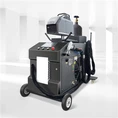
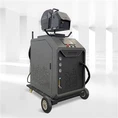
By 2025, the technological trends of laser cutting machines will focus on ultra-high power breakthroughs, intelligent upgrades, and green manufacturing innovations, while achieving key advancements in multi-process integration and ultra-precision machining. The specific trends can be summarized into six dimensions:
Fiber laser power will exceed 30kW, with international manufacturers introducing 120,000W ultra-high-power UV laser cutting machines capable of stress-free cutting of super-large components like ship sections and wind turbine towers, achieving a precision of ±0.05mm/m. High-power equipment will increase efficiency by over 30% in thick plate processing (carbon steel ≤60mm) and high-reflectivity material cutting (e.g., aluminum alloy, copper), while dynamic parameter adjustment systems optimize beam quality to reduce damage risks from reflected light.
UV (355nm), green (532nm), and fiber (1064nm) lasers will intelligently switch based on material properties:

UV lasers: Focused spot as small as 5μm, heat-affected zone <0.1mm, suitable for fine machining of FPC flexible boards and SIP packaging chips;
Green lasers: Achieve 0.07mm narrow slots in aluminum substrate cutting, 5x faster than traditional milling;
Fiber lasers: Support dynamic parameter adjustment at 60kW power with intelligent cutting systems, meeting mass production needs for multi-layer boards.
Hybrid cutting technologies (e.g., UV+green laser combination) will break through single-material limitations for diverse processing of complex workpieces.
Machine learning algorithms will establish a database of over 100,000 materials by real-time collecting data on laser power, cutting speed, and focal position, automatically matching optimal process parameters. For example, AI vision algorithms can detect 0.02mm pad offsets, enabling fully automated panel cutting with a 37% improvement in quality stability. Neural network models will predict cutting defects and dynamically adjust parameters, reducing trial-and-error costs by 40%.
Devices will integrate digital twin technology, shortening commissioning cycles by 30% through virtual debugging, with 92% accuracy in real-time condition monitoring and fault prediction. Blockchain traceability will automatically generate carbon emission reduction reports to comply with EU CBAM regulations.
Robotic loading/unloading arms + AGV material carts will enable 72-hour unmanned operation, while intelligent waste sorting systems will increase metal recovery rates to 98%. Some models will directly connect to MES systems for cloud synchronization of cutting parameters and off-peak production, reducing peak electricity costs by over 25%.
Light Source Upgrades: Fiber lasers with 45% electro-optical conversion efficiency and variable pulse technology will reduce power consumption by 30% for thin plate processing;
Cooling Innovations: Magnetic levitation vacuum pumps and air-cooling systems will replace traditional water cooling, saving 150 tons of water/year per machine. By 2025, hydrogen fuel cell cooling devices will fully replace industrial water;
Waste Recycling: 99% metal dust recovery and magnetic separation will enable secondary use of ferrous materials, while RTO incineration systems will limit VOCs emissions to <10mg/m³.
PV direct-drive systems will increase daytime clean energy utilization to 35%, while full-life-cycle carbon footprint tracking will help enterprises meet global carbon standards. Equipment certified to ISO 50001 may receive government green manufacturing subsidies (up to 20% of equipment investment).
Picosecond/femtosecond lasers will reduce heat-affected zones to the nanometer scale, suitable for cutting-edge fields like quantum chips and medical implants. For example, a UV laser cutting device certified by the FDA can machine implant-grade components like heart stents with thermal deformation <5μm. Sinofine Laser's kilowatt-level ultrafast solution is expected to be delivered in early 2025, laying the foundation for domestic EUV light source development.
The new GB/T 18462-2025 standard will establish a hierarchical evaluation system, requiring roundness ≤0.01mm and dimensional tolerance ±0.0025/100mm for thin plates (0.1mm), with eight new indicators including recast layer detection. Dynamic focus compensation will achieve 0.01mm-level precision, while vision-based correction systems will further limit errors to ±0.02mm.
Integration of laser cutting with welding, 3D printing, and other processes will meet complex demands like new energy vehicles' integrated die-castings. For example, laser-mechanical composite machining (slotting before panel dicing) increases efficiency by 50%; 5-axis laser cutting machines enable 3D PCB processing for high-density interconnect (HDI) board 立体化 trends.
Reconfigurable modular designs will support quick switching of cutting heads, worktables, and other components, accommodating full-range processing from 0.1mm thin plates to 60mm thick plates. For instance, some devices can seamlessly switch between consumer electronics (precision cutting) and aerospace (thick plate machining) by replacing laser sources of different wavelengths.
New industry standards (e.g., GB/T 18462-2025) will quantify and grade indicators like surface roughness and perpendicularity, pushing equipment quality toward international levels. Enterprises can stably achieve Class O (highest grade) machining standards through process databases (built-in 300+ material parameters) and intelligent inspection systems.
30kW fiber lasers are expected to enter mass production by 2026, increasing domestic localization rates from <40% to 60%. Companies like Sinofine Laser will break through German Trumpf's monopoly in disk lasers, advancing the localization of high-power ultrafast laser equipment.
By 2025, laser cutting machines will feature higher power, better precision, lower energy consumption, and stronger intelligence, driving the manufacturing industry toward "greenization, intelligence, and servitization" through interdisciplinary technology integration and industry standard upgrades. Enterprises should focus on three core competencies: domestic high-power laser sources, AI process optimization, and green manufacturing compliance to address dual challenges of global industrial chain restructuring and technological iteration.
------------------------
Ryder