


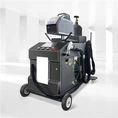
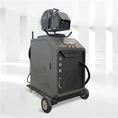

1. Laser Source
The laser source is the heart of the machine. It generates the laser beam that melts and joins the materials.
Fiber Laser: The most commonly used type in industrial welding. It offers high energy efficiency, long lifespan, and excellent beam quality.
Semiconductor Laser (Diode Laser): Often used for low-power applications or in compact machines. It has a simple structure but lower beam quality compared to fiber lasers.
2. Optical System
The optical system focuses and directs the laser beam precisely onto the workpiece.
Focusing Lens: Concentrates the laser beam to a fine point to achieve a high energy density, allowing deep or precise welds.
Reflective Mirrors: Used to guide the beam through the optical path when necessary, especially in complex setups.
3. Control System
The control system governs the machine's operation and welding process.
Software Interface: Allows users to set welding parameters such as power, speed, and pattern.
Numerical Control (CNC): Enables programmable and automated movement of the laser head and workpiece, ensuring precision and repeatability.
4. Cooling System
Laser sources generate heat during operation, so a cooling system is essential.
Water Chiller: The most common method for keeping the laser and optics at a stable temperature, which extends equipment life and prevents overheating.
5. Auxiliary Systems
These systems enhance performance, stability, and safety during the welding process.
A. Gas Protection System
Purpose: Prevents oxidation and contamination of the weld zone.
Common Gases:
Argon: Inert, provides excellent shielding for most metals.
Nitrogen: More economical, suitable for some stainless steels.
B. CCD Vision or Seam Tracking System
CCD Camera: Allows real-time monitoring of the welding area for better alignment and quality control.
Seam Tracking Sensor: Automatically adjusts the laser path to follow the joint precisely, especially useful in robotic or complex welding tasks.
Conclusion
A laser welding machine is a complex system composed of several key components, including the laser source, optical path, control software, cooling, and protective systems. Understanding these parts helps operators use the equipment more effectively and maintain high welding quality. For advanced automation, adding vision and tracking systems can further improve efficiency and consistency.
--Rayther Laser Lyra Zhang