


Overview of the Working Principle of Laser Tube Cutting Machines
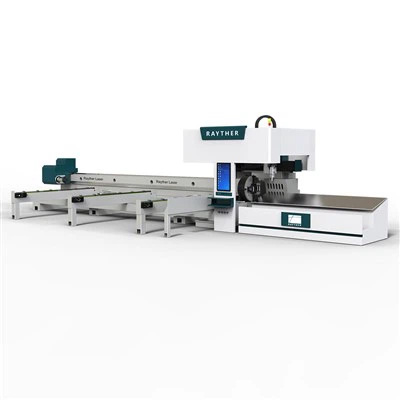
Laser tube cutting machines are mainly used for the processing and cutting of various types of pipes, such as round and square pipes. With significant advantages like high precision and rapid cutting, they are gradually replacing traditional metal cutting equipment. Their working principle involves using a laser generator to produce a high-energy, stable laser beam. Common laser generators include CO₂ lasers and fiber lasers.
Take fiber lasers as an example: inside, the optical fiber generates photons when excited by electrical energy. These photons are continuously amplified by the mirrors in the resonant cavity, forming a high-energy, high-density laser beam. This beam is transmitted to the cutting head through optical systems such as optical fibers or lens groups. During this process, with the help of optical components like convex lenses, concave lenses, and mirrors, the laser beam is focused into an extremely small spot, usually only dozens of micrometers in diameter, enabling it to instantly melt or even vaporize metal materials.
When the laser beam irradiates the surface of the pipe, the irradiated area's material rapidly melts, vaporizes, or reaches its ignition point. At the same time, a high-speed gas flow (such as nitrogen, oxygen, etc.) coaxial with the beam blows away the molten material, achieving the cutting of the pipe.
During the cutting process, the pipe rotates and moves through devices like chucks. Computer software designs and edits the cutting graphics and converts them into laser cutting instructions. The motion controller precisely controls the movement path and speed of the laser head on the pipe to complete the preset cutting task.
Analysis of the Structure of Pneumatic Variable-Diameter Wheels
The support structure of pneumatic variable-diameter wheels generally includes a fixed base, a lifting drive cylinder set upwards on the fixed base, a receiving frame driven and connected to the lifting drive cylinder, a support shaft fixed on the receiving frame, a variable-diameter wheel rotatably arranged on the support shaft, and a locking structure for fixing the variable-diameter wheel.
The fixed base is installed on a vertical mounting plate. The mounting plate is provided with at least two horizontally extended elongated holes, and at each elongated hole, a first mounting screw connected to the machine bed is installed, thereby enabling the adjustment of the left-right position of the mounting plate. The fixed base is provided with at least two vertically extended elongated holes, and the mounting plate has the same number of threaded mounting holes corresponding one-to-one. At each elongated hole on the fixed base, a second mounting screw connected to the threaded mounting hole on the mounting plate is installed, thus realizing the up-down position adjustment of the fixed base.
For example, in some variable-diameter wheel support structures, there are six horizontally extended elongated holes, with three on the left side and three on the right side of the fixed base; there are four vertically extended elongated holes, two on the left and two on the right side of the lifting drive cylinder. An adjustment block is also fixed on the mounting plate below the fixed base. A tightening screw extending upwards passes through the middle of the adjustment block. Two jacking screws extending upwards are screwed onto the adjustment block, respectively located on both sides of the tightening screw. The bottom surface of the fixed base is provided with a tightening threaded hole that matches the tightening screw.
The two jacking screws are used to press against the bottom surface of the fixed base, further assisting in the fine adjustment of the fixed base's position. The variable-diameter wheel is installed on the receiving frame through the support shaft. Both ends of the support shaft are fixed on the receiving frame by a first limit block and a second limit block respectively. The locking structure includes a positioning pin inserted into the first limit block and multiple positioning holes distributed along the circumference on either side surface of the variable-diameter wheel.
Inserting the positioning pin into one of the positioning holes can restrict the rotation of the variable-diameter wheel. On the end surface of some variable-diameter wheels with positioning holes, a scale plate corresponding one-to-one to the positioning holes is also set, facilitating operators to precisely adjust the angle of the variable-diameter wheel.
Solving the Problem of Pipe Shaking
During the laser tube cutting process, for pipes with a small diameter and long length, even when clamped by the front and rear chucks, shaking is likely to occur during rotational cutting. This is because the pipe's slenderness ratio is relatively large, resulting in insufficient rigidity. During the cutting process, affected by factors such as the thermal force of the laser beam, the impact force of the high-speed gas flow, and the uneven clamping force of the chuck, the pipe is extremely prone to displacement and vibration.
The emergence of pneumatic variable-diameter wheels has effectively improved this situation. When the pipe is placed on the laser tube cutting machine, the pneumatic variable-diameter wheel can adjust its height through the lifting drive cylinder according to the pipe's diameter, ensuring full contact between the wheel and the pipe. The circumferential surface of the variable-diameter wheel is usually made of special rubber or polyurethane materials, which have good elasticity and friction, enabling it to closely fit the outer wall of the pipe and provide upward support.
For example, in some practical application scenarios, for a slender round pipe with a diameter of 20mm and a length of 2m, without the support of a pneumatic variable-diameter wheel, the shaking amplitude of the round pipe during the cutting process can reach ±2mm, seriously affecting the cutting accuracy. After installing the pneumatic variable-diameter wheel, by precisely adjusting its position and height, the shaking amplitude of the round pipe can be controlled within ±0.2mm, ensuring the stability of the cutting process and greatly improving the cutting quality.
The Role in Improving Cutting Accuracy
1. Precise Support to Ensure Cutting Accuracy
The cutting accuracy of laser tube cutting machines is restricted by various factors, and the stability of the pipe during the cutting process is one of the key factors. Pneumatic variable-diameter wheels can provide precise support points under the pipe according to the actual situation of the pipe. When the pipe rotates for cutting driven by the chuck, the variable-diameter wheel is in close contact with the pipe and rotates synchronously, providing stable support force for the pipe, effectively reducing the deformation and displacement of the pipe caused by factors such as its own gravity and cutting force.
Take the cutting of rectangular pipes as an example. Due to the complex force conditions on each side of the rectangular pipe, it is prone to twisting deformation during the cutting process. Pneumatic variable-diameter wheels can provide support at the four corners and sides of the rectangular pipe, ensuring the shape stability of the rectangular pipe throughout the cutting process. This allows the laser cutting head to accurately cut along the preset path, thereby controlling the cutting accuracy within a very small error range. Generally, the cutting accuracy can be improved to within ±0.1mm.
2. Collaborating with Chucks for Efficient Clamping
Pneumatic variable-diameter wheels work in tandem with the front and rear chucks to further enhance the clamping effect of the pipes. The front and rear chucks are mainly responsible for providing clamping force at both ends of the pipe to ensure the axial fixation of the pipe, while the pneumatic variable-diameter wheels provide auxiliary support force at the middle or other parts of the pipe that need support. The support force of the variable-diameter wheels combines with the clamping force of the chucks, keeping the pipe in a stable stressed state throughout the cutting process.
For example, when processing some large-diameter thin-walled pipes, relying solely on the chuck clamping is likely to cause local deformation of the pipe, affecting the cutting accuracy. Pneumatic variable-diameter wheels can provide uniform support force inside or outside the pipe, offsetting the adverse effects of the chuck clamping force and cutting force on the pipe, ensuring the roundness and straightness of the pipe during the cutting process, and thus improving the cutting accuracy and surface quality.
Expanding the Range of Pipe Processing
1. Adapting to Pipes of Different Diameters
One of the significant advantages of pneumatic variable-diameter wheels is their ability to adapt to the processing of pipes with various diameters. Through the coordination of the lifting drive cylinder and the locking structure, the variable-diameter wheel can be quickly adjusted to a position and angle that matches pipes of different diameters.
Whether it is small-diameter precision pipes, such as stainless steel pipes with a diameter of 5mm used in medical equipment, or large-diameter industrial pipes, such as steel pipes with a diameter of 300mm used in the construction industry, pneumatic variable-diameter wheels can provide effective support. In actual production, a laser tube cutting machine equipped with pneumatic variable-diameter wheels can switch between processing pipes of different diameters in a short time without the need to frequently replace tooling fixtures, greatly improving production efficiency and the versatility of the equipment.
2. Meeting the Processing Requirements of Special Pipes
In addition to common round and square pipes, laser tube cutting machines also encounter the processing requirements of various special-shaped pipes in practical applications, such as elliptical pipes and polygonal pipes. Due to their irregular shapes, these special-shaped pipes have more complex force conditions during the cutting process, placing higher demands on the support and clamping systems.
Pneumatic variable-diameter wheels can provide personalized support solutions for special-shaped pipes by flexibly adjusting their positions and angles. For example, for elliptical pipes, the variable-diameter wheels can provide different support forces in the long and short axis directions of the ellipse to ensure the stability of the elliptical pipe during the cutting process.
For polygonal pipes, the variable-diameter wheels can adjust the positions and quantities of the support points according to the number of sides and angles of the polygon, achieving precise support for the polygonal pipe, thus enabling the laser tube cutting machine to successfully complete the processing of various special-shaped pipes and expanding the application field of the laser tube cutting machine.
Case Studies of the Application of Pneumatic Variable-Diameter Wheels
1. Automotive Parts Manufacturing
In the automotive parts manufacturing industry, laser tube cutting machines are widely used in the production of various pipe components, such as automotive seat frames and vehicle frame parts. Take an automotive manufacturing enterprise as an example. When producing automotive seat frames, this enterprise needs to cut a large number of steel pipes with different diameters and shapes.
Before introducing laser tube cutting machines equipped with pneumatic variable-diameter wheels, due to problems such as pipe shaking and unstable support, the accuracy of the cut parts was low, and the rejection rate was as high as 10%. After adopting the new equipment, the pneumatic variable-diameter wheels effectively solved the problem of pipe shaking, significantly improving the cutting accuracy. The rejection rate was reduced to within 2%, and at the same time, the production efficiency increased by 30%. This saved a large amount of raw material and production costs for the enterprise and enhanced the product quality and market competitiveness.
2. Fitness Equipment Production
Fitness equipment manufacturers have extremely high requirements for the cutting accuracy and surface quality of pipes during processing. A well-known fitness equipment manufacturer used laser tube cutting machines equipped with pneumatic variable-diameter wheels when producing products such as dumbbell bars and barbell bars.
The pneumatic variable-diameter wheels provided stable support for pipes of different diameters, enabling the dimensional accuracy of the cut pipes to be controlled within ±0.2mm and the surface roughness to reach below Ra0.8μm, meeting the strict requirements of high-end fitness equipment for the accuracy and surface quality of components. At the same time, since the equipment can quickly switch between processing pipes of different diameters, the production efficiency of the enterprise has been significantly improved, enabling it to better meet the diverse market demands for fitness equipment.
Conclusion and Outlook
Pneumatic variable-diameter wheels play a crucial role in laser tube cutting machines. By solving the problem of pipe shaking, improving cutting accuracy, and expanding the range of pipe processing, they provide strong support for the efficient and precise operation of laser tube cutting machines. Judging from practical application cases, whether in the automotive parts manufacturing or fitness equipment production industries, laser tube cutting machines equipped with pneumatic variable-diameter wheels have demonstrated obvious advantages, improving the production efficiency and product quality of enterprises.
With the continuous development of the manufacturing industry, the demands for the accuracy, efficiency, and diversification of pipe processing will continue to increase. In the future, pneumatic variable-diameter wheels are expected to be further optimized and innovated in terms of structural design, material selection, and control technology.
For example, more advanced intelligent control technology can be adopted to enable pneumatic variable-diameter wheels to automatically adjust the support force and position according to the pipe's material, diameter, and cutting process requirements, achieving more precise and efficient pipe processing. New high-strength and high-elasticity materials can be developed for the manufacture of variable-diameter wheels to further improve the service life and support performance of the variable-diameter wheels.
It is believed that with the continuous advancement of technology, pneumatic variable-diameter wheels will play an even greater role in the field of laser tube cutting machines and make greater contributions to the development of the manufacturing industry.
--Rayther Laser Jack Sun--