


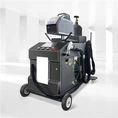
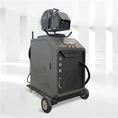
Precautions for Using Laser Welding Machine

1.Safety operation category
·Safety regulations that must be followed when using a laser welding machine
Protective equipment: Special laser protection glasses must be worn to avoid direct laser exposure to the eyes; wear heat-resistant work clothes to prevent burns from flying debris.
Environmental safety: Ensure good ventilation in the working area to avoid the accumulation of welding fumes; do not operate near flammable or explosive materials.
Equipment inspection: Before starting the machine, check if the laser light path is normal, if the emergency stop button is sensitive, and if the cooling water circulation system is leaking.
Prohibited behaviors: Do not touch the laser beam or the hot welding area directly with your hands; non-operational personnel are not allowed to approach the equipment.
·Wear laser protection glasses
The laser beam has high energy, and direct exposure to the eyes can cause permanent damage to the retina.
Yes, different wavelengths (such as 1064nm fiber laser, 10.6μm CO₂ laser) require corresponding wavelength protective glasses, and the lens color and optical density (OD value) must comply with safety standards.
2.Power On & Preparation Category
·The correct startup procedure for a laser welding machine
Connect the main power supply, turn on the water chiller, and ensure that the water temperature remains stable at 20-25℃.
Turn on the power supply of the control system, start the laser generator (preheat for 10-15 minutes according to the equipment instructions).
Check if the parameter settings on the software interface are zeroed, and manually test if the movement of the workbench is smooth.
Install and calibrate the welding lens, and use special tools to clean the dust on the lens surface.
·Preparation of materials before welding
Clean the surface of the material: Remove oil stains, oxide layers or coatings (using alcohol or sandpaper), to avoid affecting the welding effect.
Fix the material: Use fixtures to ensure the precise position of the workpiece, to avoid displacement during welding and resulting in weld misalignment.
Determine the welding parameters: Set the laser power, pulse width, frequency, etc. according to the material thickness and material type (such as stainless steel, aluminum alloy, copper).
3.Fault Handling Category
·Discontinuous or broken weld seams during welding
Material issues: Severe surface oxidation or presence of impurities require re-cleaning; Inconsistent material thickness leads to inconsistent energy absorption.
Improper parameters: Insufficient laser power or too fast welding speed results in insufficient formation of the molten pool; Low pulse frequency and excessive weld point spacing.
Optical path deviation: Lens contamination or deviation in optical alignment requires cleaning the lens or recalibrating the optical path.
·When the equipment displays an alarm stating "Cooling system failure",
Check if the water level of the chiller is too low and replenish deionized water (avoid using tap water to prevent scaling).
Check if the pump is running. If not, it might be due to a power supply or pump failure. Contact maintenance for repair.
Check if the water pipes are blocked or leaking. Clean the pipes or replace the seals.
4.Maintenance and Repair Category
·Daily maintenance
Lens cleaning: Use a lint-free cloth dipped in acetone to wipe the focusing mirror and reflecting mirror every day to remove dust and debris.
Light path inspection: Check the alignment of the light path every week to ensure the laser spot is centered. If necessary, re-calibrate.
Cooling system: Replace the filter of the water cooler every month and the deionized water every quarter to prevent water quality deterioration and affect heat dissipation.
·Not used for a long time
Turn off all power supplies, drain the water in the water cooler to avoid freezing at low temperatures and damaging the pipelines.
Cover the equipment with a dust cover to prevent dust accumulation; apply a special protective agent on the surface of the lenses to avoid moisture and oxidation.
If the equipment is shut down for more than 1 month, preheat for 30 minutes before restarting and check if all components are functioning normally.
--Rayther Laser Camila Wang