


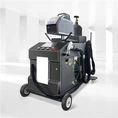


In the field of modern industrial welding, laser welding machines and MIG welding (Metal Inert Gas Welding) are two widely used technologies. Each of them plays an important role in different scenarios with their unique working principles and performance characteristics. The following is a detailed comparison of the advantages and disadvantages of the two from multiple dimensions.
Comparison of Applicable Materials and Thickness
Laser welding machines have certain advantages in terms of material adaptability. They can weld a wide range of materials, including carbon steel, stainless steel, aluminum alloys, titanium alloys and other metal materials, and can even weld some special materials with high hardness and high melting points. However, they are more sensitive to the surface state of materials. If there are oil stains, rust and other substances on the material surface, the welding quality will be affected. In terms of welding thickness, laser welding is more suitable for thin plate welding. Generally, it can achieve good welding results for materials with a thickness of 0.1-3mm. When the material thickness exceeds a certain range, the welding difficulty will increase significantly, requiring higher-power equipment, and the cost will also rise accordingly.
MIG welding is also applicable to a variety of metal materials, such as low-carbon steel, low-alloy steel, aluminum alloys, etc., and is especially widely used in the welding of aluminum and aluminum alloys. It has relatively low requirements for the cleanliness of the material surface, and a certain degree of stains or oxide layers have little impact on the welding quality. In terms of welding thickness, MIG welding is better at welding medium and thick plates, and can easily handle materials with a thickness of 3-10mm. Through multi-layer and multi-pass welding, it can also weld thicker workpieces.
Comparison of Welding Quality
The welding quality of laser welding machines is excellent. Due to its high energy density and concentrated heating, the welding heat-affected zone is extremely small, the deformation of the workpiece is very small, and it can well ensure the dimensional accuracy and appearance quality of the workpiece. The weld has the characteristics of large depth-to-width ratio, high strength, good sealing, etc. The weld surface is smooth and beautiful, and usually does not require subsequent processing procedures such as grinding.
The weld formation of MIG welding is relatively good, but the welding heat-affected zone is large, and the workpiece is prone to deformation, especially in thin plate welding, the deformation problem is more prominent. The strength and sealing of the weld can also meet general industrial requirements, but compared with laser welding, it is slightly insufficient in some high-precision and high-demand occasions.
Comparison of Welding Efficiency
Laser welding machines have a fast welding speed. Because of their concentrated energy, no filler wire is needed in the welding process (except for some special cases), and high-speed continuous welding can be realized. For some complex weld trajectories, precise control can be achieved through automated equipment to further improve welding efficiency, which is especially suitable for continuous operations in mass production.
The welding speed of MIG welding is relatively slow. Because it is necessary to continuously feed the wire as the filling material, the matching between the wire feeding speed and the welding speed must be controlled during the welding process. In medium and thick plate welding, multi-layer welding is often required, which will increase the welding time and affect the overall efficiency. However, in the welding of some simple long and straight welds, its efficiency can also meet the production needs.
Comparison of Costs
The initial investment cost of laser welding machines is relatively high. The equipment itself is expensive, especially high-power laser welding equipment. At the same time, supporting cooling systems, control systems, etc. are also needed, so the initial capital investment is large. In addition, the maintenance cost of the equipment is not low. The replacement cost of core components such as laser generators is high, and the technical level requirements for operators are also high, requiring professional training to work.
The initial investment cost of MIG welding equipment is low. The equipment structure is relatively simple, the price is relatively affordable, and it is suitable for the budget needs of small and medium-sized enterprises. Its maintenance cost is also low, and consumables such as welding wires and protective gases are cheap and easy to obtain. The training cycle for operators is relatively short, and ordinary people can perform basic welding operations after simple training.
Comparison of Operation and Maintenance
The operation of laser welding machines has high technical requirements. Operators need to be familiar with the control system of the equipment and accurately set welding parameters, such as laser power, welding speed, defocus amount, etc. Small deviations in parameter settings may affect the welding quality. In terms of maintenance, the laser generator needs regular cleaning and inspection, and the cooling system must ensure normal operation, otherwise it may affect the service life and welding performance of the equipment.
The operation of MIG welding is relatively simple and easy to learn. Operators only need to master the basic adjustment methods of parameters such as wire feeding speed, welding current, and voltage to perform welding operations. The maintenance of the equipment is also relatively convenient. It mainly involves regular inspection of the wire feeding mechanism, welding torch and other components to ensure their normal operation, and the replacement of consumables is also relatively convenient.
In conclusion, both laser welding machines and MIG welding have their own advantages and disadvantages. In practical applications, the appropriate welding technology should be selected according to specific welding requirements, such as material type, thickness, welding quality requirements, production batch and cost budget.
--Rayther Laser Jack Sun--