


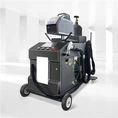
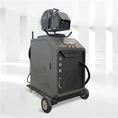


Compared with MIG (Metal Inert Gas) welding machines, laser welding machines have the following significant advantages:
1. **Fast welding speed and high efficiency**:
Laser welding machines use a laser beam with a high energy density as a heat source. The laser energy is released intensively and can instantly melt and weld materials together. In some large-scale production scenarios, such as the welding of auto parts, laser welding can complete a large amount of welding work in a short time, greatly improving production efficiency. For example, when welding certain parts of an automobile body using laser welding, the speed can reach several times or even higher than that of MIG welding.
2. **High welding precision**:
The spot diameter of the laser beam is extremely small and can reach the micrometer level, enabling precise positioning and welding. This makes laser welding suitable for the welding of tiny parts and precision electronic components, such as the welding of chips inside mobile phones and the welding of watch components. Due to the size limitations of the arc and welding wire in MIG welding, its welding precision is relatively low.
3. **Small heat-affected zone**:
During the laser welding process, the action time of the laser beam is extremely short, and the energy is highly concentrated, only generating local high temperatures at the welding site, and the surrounding materials are less affected by heat. This helps to reduce welding deformation and stress concentration, which is very important for the welding of some heat-sensitive materials or parts with high requirements for dimensional accuracy. In contrast, the arc heat distribution in MIG welding is relatively extensive, and the heat-affected zone is larger, making it prone to welding deformation.
4. **Good weld quality**:
The weld formed by laser welding is narrow and deep. The structure of the weld is dense, with high strength, and the surface is smooth, and the probability of defects such as pores and cracks is relatively low. High-quality welds can reduce subsequent processing and treatment procedures, such as grinding and repair welding. The width of the weld in MIG welding is relatively wide, and the surface quality may not be as good as that of laser welding, requiring more subsequent processing to ensure the appearance and quality of the weld.
5. **Non-contact welding**:
Laser welding does not require direct contact with the workpiece. Welding is achieved through the irradiation of the laser beam, avoiding damage or contamination to the surface of the workpiece due to contact, which is particularly suitable for the welding of materials or products with high requirements for surface quality. In MIG welding, the welding wire needs to be in contact with the workpiece, which may have a certain impact on the surface of the workpiece in some cases.
6. **Easy automation integration**:
Laser welding machines can be conveniently integrated with robots, automated production lines, etc. to achieve automated welding operations. Through programming and control systems, the parameters of the laser and the welding trajectory can be precisely controlled to meet the welding requirements of workpieces with different shapes and sizes. In modern manufacturing, automated welding is of great significance for improving production efficiency and ensuring product quality stability, while MIG welding is relatively more complex in terms of automation integration.
7. **Capable of welding a variety of materials**:
Laser welding can not only weld common metal materials such as steel, aluminum, and copper, but also achieve the welding of some difficult-to-weld materials or dissimilar materials, such as the welding of ceramics and metals, and the welding between different metals. With the continuous development of laser technology, its application prospects in the field of new material welding are also becoming broader. Although MIG welding can also weld a variety of materials, its welding capabilities for some special materials are relatively limited.
For more information on laser welding machines, please contact: Rayther@raytherlaercutter.com